
HACCP Awareness & Implementation Training: Build Your HACCP Plan from the Ground Up
Hazard Analysis and Critical Control Points (HACCP) is not just a certification—it’s a proactive, science-based framework that is the global gold standard for preventing food safety hazards. This HACCP Awareness & Implementation Training is your definitive two-part course, designed to take you and your team from foundational understanding to practical application.
The first half demystifies the core concepts, purpose, and legal importance of HACCP, building crucial awareness. The second half transitions into actionable implementation, guiding you step-by-step through the Codex Alimentarius 12-step process—from conducting a hazard analysis to establishing monitoring procedures and corrective actions.
This course provides the complete toolkit to not just understand HACCP based on MS 1480, but to confidently begin building and documenting your own HACCP-based food safety system.
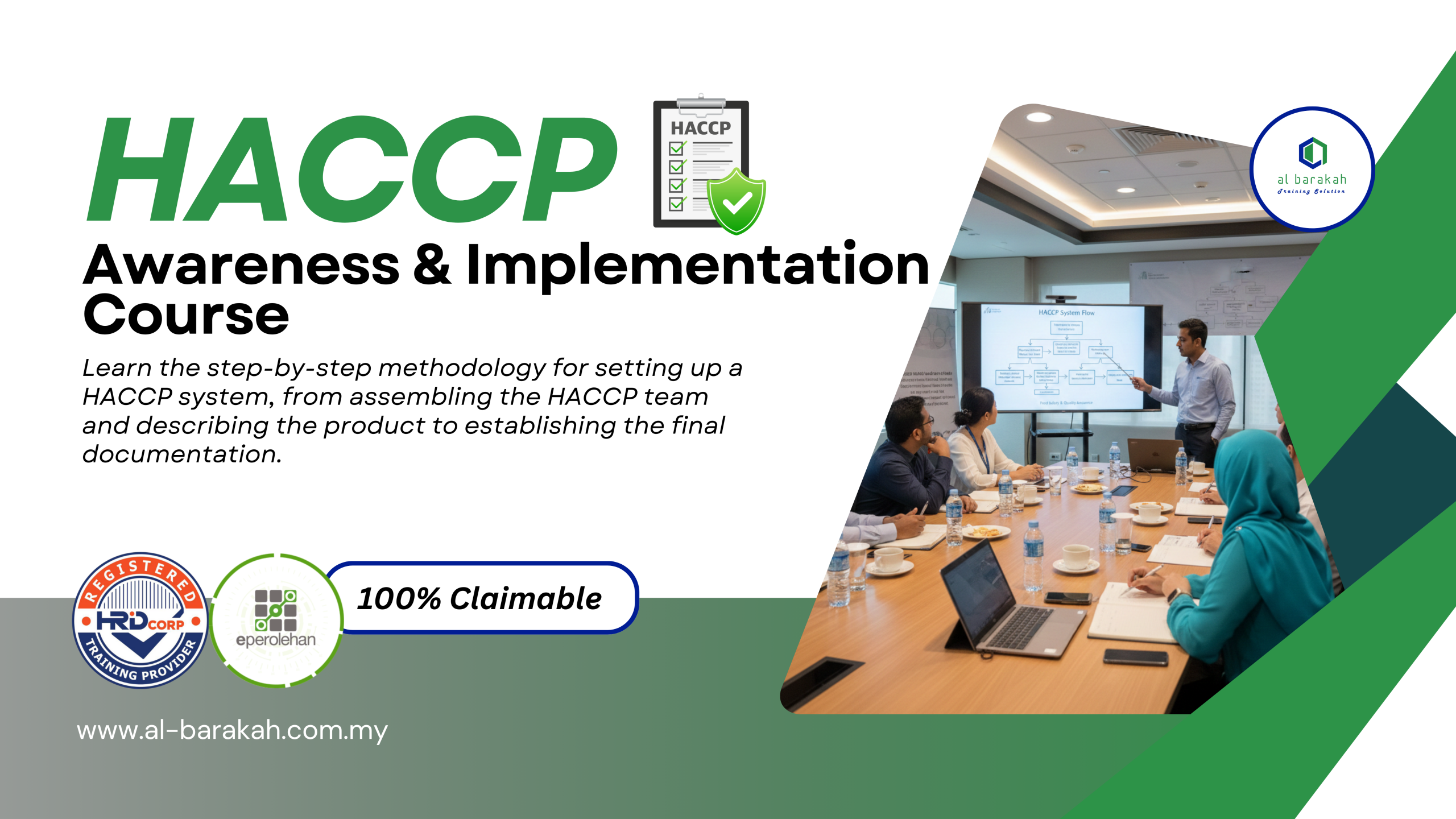
The Critical Importance of HACCP Training:
Implementing HACCP is a fundamental requirement for any serious food business. It’s the difference between reacting to food safety failures and systematically preventing them. This training is critical because it:
- Transforms Theory into Practice: Bridges the common gap between knowing what HACCP is and knowing how to do it.
- Ensures Regulatory & Customer Compliance: Meets the requirements of Malaysia’s Food Act and is demanded by global retailers and manufacturers.
- Protects Your Brand and Consumers: Proactively identifies and controls biological, chemical, and physical hazards, preventing costly recalls and protecting public health.
- Lays the Groundwork for Certification: Is the essential first step toward achieving FSSC 22000, ISO 22000, or other GFSI-benchmarked certifications.
Objective of This Intensive Course:
The primary objective of this intensive two-day training course is to empower your food safety and operational personnel to move beyond theory and confidently implement and maintain a functional HACCP system|.
To equip participants with a thorough understanding of HACCP principles and provide them with the practical knowledge and skills necessary to actively participate in or lead the development, implementation, and initial maintenance of a HACCP plan for their organization, in line with Codex Alimentarius guidelines.
Key Topics Covered: From Foundation to Implementation
This course provides a deep dive into the technical core of food safety management:
Awareness: Food safety hazards, the history and evolution of HACCP, and its role in an integrated food safety management system.
Prerequisite Programs (PRPs): Understanding Good Manufacturing Practices (GMP), sanitation, and other foundations essential for HACCP success.
The 12 Steps: Detailed walkthrough of all five preliminary steps and the seven core HACCP principles based on Malaysian Certification Scheme (MCS) of MS1480.
Hazard Analysis: Practical techniques for identifying and evaluating significant hazards.
CCP Determination: Using decision trees to establish genuine Critical Control Points.
Plan Development: Setting critical limits, monitoring procedures, corrective actions, and verification activities.
Documentation & Review: Establishing record-keeping procedures and maintaining the plan.
Practical Benefits: Applying Knowledge Daily
Your team will leave ready to:
Speak the Language of HACCP and contribute meaningfully to food safety discussions.
Participate in HACCP Team Meetings with confidence, offering insights on potential hazards.
Accurately Perform Monitoring Tasks at identified CCPs, understanding their vital role.
Document Procedures Correctly, creating the essential records needed for verification and audit trails.
Initiate Corrective Actions when a deviation occurs, following a predefined plan.
Training Methodology: Engaging and Effective Learning
This is an intensive, hands-on, two-day training. The approach is highly practical, moving from foundational knowledge to deep technical application.
Expert-Led Instruction from experienced food safety professionals.
Real-World Case Studies & Examples relevant to the Malaysian food industry.
Interactive Group Discussions to solve common food safety challenges.
Visual Aids and Practical Demonstrations to clarify complex concepts.
Q&A Sessions to address your specific operational questions.
Don’t leave food safety to chance. Empower your team with the foundational knowledge of HACCP that is critical for compliance, consumer protection, and commercial success. Choose from our flexible 2-Day in-house training options, delivered in English or Bahasa Malaysia.
The Central Hub: HACCP Food Safety Training
Think of this course as the core module in a university program. It’s the essential, integrative subject that connects all others. Here is the relational framework:
1. The Absolute Prerequisites (The “Must-Have-Before” Layer):
Food Handling Course (Kursus Pengendali Makanan): This is the employee-level foundation. It teaches how to handle food safely. Our HACCP course explains why those rules exist and how they are systematized into a plan. (Link logic: “This course builds on the safe practices learned in our basic Food Handling Course by showing you how to structure them into a preventive system.”)
GMP Awareness & Implementation Course: GMPs are the Prerequisite Programs (PRPs). You state it in your outline. You CANNOT implement HACCP effectively without solid GMPs. These courses are the direct, non-negotiable foundation. (Link logic: “A robust HACCP plan is built upon the solid foundation of Good Manufacturing Practices established in our GMP courses.”)
2. The Parallel & Specialized Knowledge (The “Context & Application” Layer):
Navigating Food Laws: Malaysia’s Food Acts: This provides the legal ‘why’. The law mandates food safety systems like HACCP. Our course provides the technical ‘how’ to meet that legal requirement. (Link logic: “Once you understand the legal requirements from our Food Laws course, this training provides the methodology to comply with them.”)
Halal Awareness Training & Food Allergen Training: These are specialized hazard controls. In a HACCP plan, allergen management or halal integrity points often become Critical Control Points (CCPs). This course teaches the HACCP framework; those courses detail how to control specific hazards within it. (Link logic: “Effectively manage specific hazards like allergens, covered in our dedicated training, by correctly identifying and controlling them as CCPs within your HACCP plan.”)
Comprehensive Food Safety for Food Service: This is a sector-specific application. It incorporates HACCP principles tailored for restaurants/catering. Our course provides the deep-dive, generic HACCP methodology that underpins it.
3. The Breakdown vs. The Culmination (The “Before & After” Layer):
HACCP Awareness Training: This is Part 1 of your combined course. It’s for those who only need the “what is it” knowledge.
HACCP Implementation Course: This is Part 2 of your combined course. Your new “Awareness & Implementation” course replaces and unifies these two, offering a more cohesive journey. The link here is a consolidation message.
HACCP Verification and Internal Auditing Training: This is the direct sequel. You BUILD your HACCP system in the “Awareness & Implementation” course. You then AUDIT, VERIFY, and MAINTAIN it in the “Verification” course. This is your strongest progression link. (Link logic: “After developing your HACCP plan in this course, empower your team to audit and maintain it with our HACCP Verification and Internal Auditing Training.”)
4. The Advanced System Frameworks (The “Where HACCP Fits” Layer):
ISO 22000 & FSSC 22000 Awareness Training: These are integrated management system standards that have HACCP as their core technical component. Our “HACCP Awareness & Implementation” course teaches you that core technical component. It is the single most important technical skill needed to achieve these certifications. (Link logic: “Master the core technical element of FSSC 22000 and ISO 22000 by learning to develop and implement a HACCP plan in this foundational course.”)
Where This Course Fits in Your Food Safety Journey
This HACCP Awareness & Implementation Training is the central pillar in a comprehensive food safety competency framework. It connects all levels of your organization’s learning path:
Start with the Basics: Ensure all personnel have undergone basic Kursus Pengendali Makanan and understand GMP principles through our GMP Awareness/Implementation courses. These are the essential building blocks.
Build Your System (You are here): This course is where you integrate that knowledge to construct your preventive HACCP plan. It is the direct application of legal knowledge from Navigating Food Laws and the framework for controlling specific risks covered in Food Allergen and Halal Awareness training.
Maintain and Advance: Once your HACCP system is built, use our HACCP Verification and Internal Auditing Training to ensure its ongoing effectiveness. This skill set is also the critical technical foundation for pursuing advanced global certifications like ISO 22000 and FSSC 22000.
Ready to Build Your HACCP Plan?
Take the first critical step from awareness to implementation. Contact us for the next available public session or to discuss customized in-house training for your team.
Click Here to Inquire Now or email us directly at sa***@************om.my to schedule your in-house training session.