
Overview

Master Food Defense & Protect Your Supply Chain from Intentional Harm

Crime, sabotage, and terrorism – while shocking, these are real threats to the global food supply chain. Food Defense is the dedicated discipline of protecting food products from intentional adulteration by biological, chemical, physical, or radiological agents aimed at causing harm. It goes beyond accidental contamination (food safety) to address to address malicious acts of tampering and food terrorism to threaten public health, cause economic damage, and destroy consumer trust.

With evolving global regulations like the FDA’s FSMA Rule on Intentional Adulteration and GFSI scheme requirements (BRCGS, FSSC 22000), moving from basic awareness to actionable implementation is critical. This training provides the foundational knowledge to build your organization’s first line of defense.

For a foundation in local legal compliance, we recommend our course on Food laws that will covers all the governing laws on food safety.
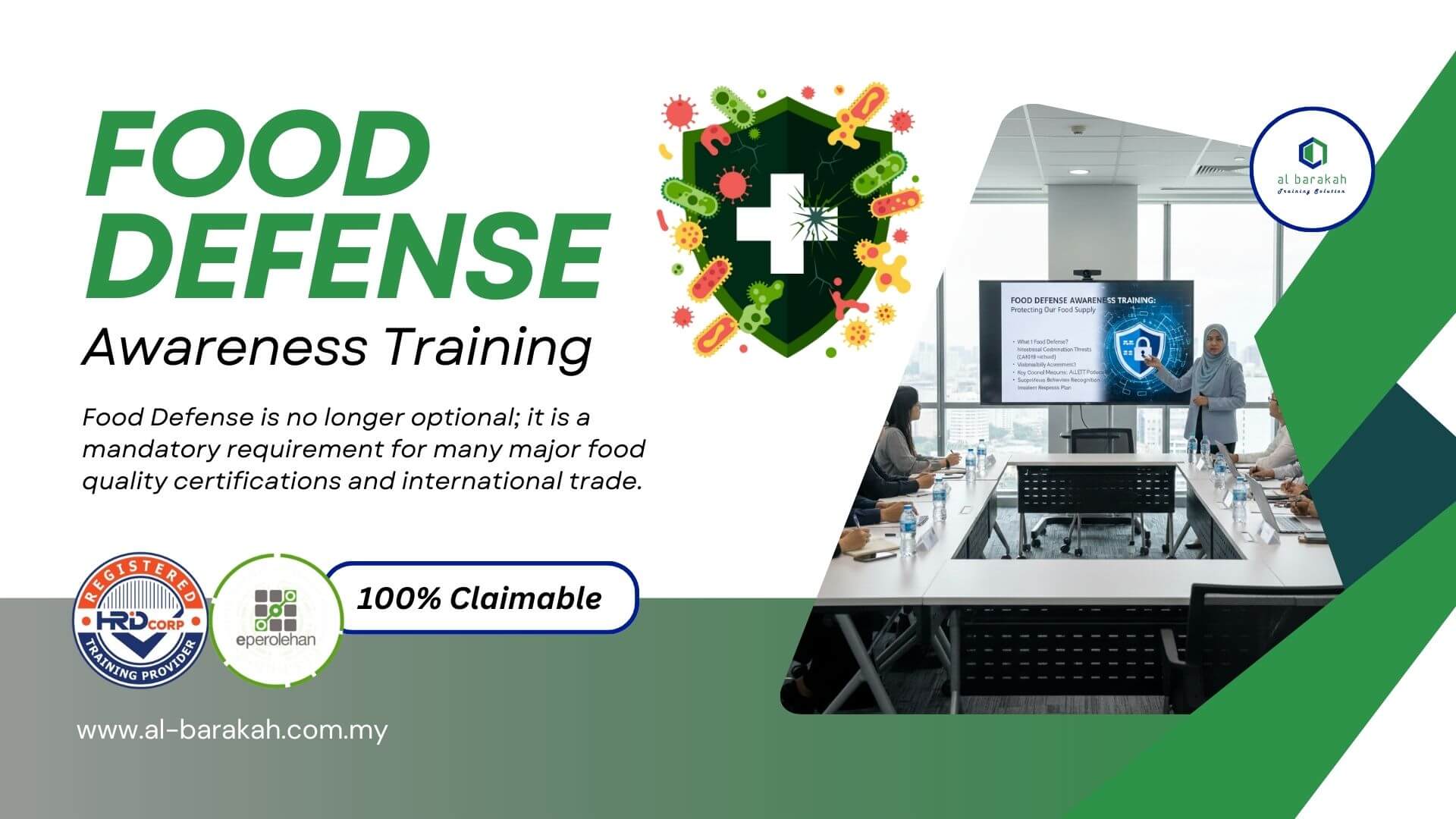
Food Defense training

The Critical Importance of This Training

A single act of intentional adulteration can lead to catastrophic brand loss, legal liability, and public health crises. This training is not just a regulatory checkbox; it is an investment in your company’s resilience and reputation – a core requirement for GFSI food safety certifications like FSSC 22000 and BRCGS.

It empowers your entire workforce to become active guardians of your products, creating a proactive food defense culture that deters, detects, and mitigates threats.

Course Objective

The purpose of the food defense awareness program is to establish a consistent, vigilant food defense culture within your organization. Participants will gain the knowledge to contribute to protecting the food supply from dynamic and evolving acts of intentional adulteration, from small-scale sabotage to wide-scale terrorism.

Key Topics Covered

  • Fundamentals & Regulatory Landscape of Food Defense

  • Conducting Vulnerability Assessments (Key Activity Types)

  • Developing & Implementing Mitigation Strategies

  • Building a Functional Food Defense Plan

  • Empowering Employees as Human Sensors

  • Overview of Food Defense Certification Schemes

Selecting Appropriate Mitigation Measures (Physical Security, Personnel Security, Operational Security). These measures dovetail with foundational Good Manufacturing Practices (GMP) and are integral to management systems like ISO 22000 and FSSC 22000.

Practical Daily Benefits for Employees

After this training, your team will be able to:

  • Identify anomalies: Spot unusual activities, unauthorized personnel, or signs of tampering in their work area. This vigilant mindset complements core HACCP principles for controlling unintentional hazards.

  • Assess vulnerabilities: Understand which processes in their daily tasks are most at risk.

  • Execute protocols: Confidently follow access control, verification, and reporting procedures.

  • Report effectively: Know exactly how and when to report suspicious incidents through proper channels.

  • Uphold culture: Act as a vigilant, trained component of the company’s overall defense system.

Training Methodology

Our expert-led session employs an engaging mix of:

  • Instructor-Led Presentations on core concepts and standards.

  • Real-World Case Studies of past food defense incidents.

  • Interactive Workshops on vulnerability identification.

  • Scenario-Based Role-Playing to practice response protocols.

  • Q&A Sessions to address site-specific challenges.

Recommended Prerequisites/Related Courses

To build a comprehensive food safety management system, we recommend:

Secure Your Supply Chain. Empower Your Team.

Empowered. Vigilant. Secure. 

After this training, your employees will be transformed into the first line of defense. They will return to work equipped with the critical skills to identify vulnerabilities, spot suspicious activity, and execute protocols that protect your products, your consumers, and your brand’s reputation from intentional harm.

Click Here to Inquire Now or email us at sa***@************om.my to schedule your in-house training.

Level

Intermediate - Advance

Duration

1 Day

Languange

B. Malaysia and English

Training Mode

Public & In-House

Training Module Content

Module 1: Introduction to Food Defense

  • Definitions: Food Safety vs. Food Defense vs. Food Fraud
  • Historical Incidents and Lessons Learned
  • Global Regulatory Drivers (FSMA IA, GFSI, Malaysia’s Requirements)

Module 2: Threat Assessment & Motivation

  • Understanding Potential Attackers: Motivations and Opportunities

  • Types of Intentional Adulteration

Module 3: Conducting a Vulnerability Assessment

  • Identifying Critical Points in Your Process
  • Using the “Three Elements” Method (Public Health Impact, Degree of Access, Ability of Attacker)

Module 4: Mitigation Strategies & Food Defense Plan

  • Selecting Appropriate Mitigation Measures (Physical Security, Personnel Security, Operational Security)
  • Components of a Documented Food Defense Plan
  • Implementing, Exercising, and Maintaining the Plan

Module 5: Building a Culture of Awareness

  • Employee Training Tools and Techniques
  • The Role of Every Employee as a “Human Sensor”
  • Reporting Procedures for Suspicious Activity

Module 6: Certification & Summary

  • Overview of Food Defense Audit and Certification Schemes
  • Key Takeaways and Action Plan

Learning outcome

Upon completion, participants will achieve:

  • clear understanding of food defense requirements and their importance.

  • The ability to identify vulnerabilities within food operations.

  • Knowledge of key mitigation strategies to reduce risks.

  • Insight into developing and maintaining an effective food defense plan.

  • Empowerment to act as a vigilant, trained employee, strengthening the company’s overall defense culture.

Want to train your entire team?

Get a customized in-house training quote today! Contact us or click below.

Who is this training for?

This course is essential for:

  • Food Safety & Quality Assurance Team Members

  • Production & Operations Managers

  • Security and Facility Personnel

  • Logistics and Supply Chain Staff

  • Anyone involved in the implementation or maintenance of a Food Defense Plan.

Target Industry

  • Food & Beverage Manufacturing

  • Halal Food Production & Certification

  • Food Logistics, Warehousing, and Distribution

  • Packaging Manufacturing for Food

  • Agricultural Production and Processing

  • Any business seeking GFSI certification (BRCGS, FSSC 22000, IFS, etc.).

Any business seeking GFSI certification (BRCGS, FSSC 22000, IFS, etc.). Food Defense is a critical component of a holistic food safety system. Build your team’s expertise with our Comprehensive Food Safety suite, including Allergen Control and the mandatory basic Food handling course.

Participants requirements:

Pen & Notes.

Recognized training provider

Trusted By

Since 2009, we have work with more than 3,000 brands including…

Halal awareness training a training course based on the MPPHM 2022

Clients' Review

“This Food Defense training moved our thinking from general security to targeted food defense. The systematic approach to conducting a vulnerability assessment was invaluable. We now have a clear, actionable plan for implementing mitigation strategies at our key process steps, significantly strengthening our facility’s resilience.”

En. Khairul Attar | Site Security & Safety Manager, PrimePack Foods

“The module on insider threats was an eye-opener. The trainer provided a respectful yet critical framework for understanding behavioral indicators and strengthening access control protocols. This has empowered our entire team to be proactive observers, creating a more secure and vigilant culture from within.”

Puan Nor Aliya Hassan | Operations Director, Bayan Beverages Sdn Bhd

TRAINER PROFILE

Learn From Industry Experts, Not Just Theorists

Every trainer in our network is meticulously vetted against a stringent set of criteria, ensuring you learn from professionals who have not only taught the standards but have implemented, audited, and lived them in the Malaysian food industry.

Our Core Selection Criteria for Food Safety Trainers:

Minimum 10-15 Years of Hands-On Industry Experience: Each trainer is a seasoned professional with a substantial career in food manufacturing, quality assurance, or technical management within Malaysia. They bring stories from the factory floor, not just the textbook.

Dual Credentials – Certified Practitioner & Certified Trainer: They hold active professional certifications (e.g., Certified HACCP Auditor,  FSSC Professional) and are skilled in adult training methodologies (e.g., Certified Train-The-Trainer). They know the subject and how to teach it effectively.

Audit & Certification Body Experience: Many of our lead trainers have direct experience working with or as auditors for SIRIM, the Ministry of Health (MOH), and other certification bodies. They provide insider perspectives on what auditors truly look for.

Specialization in Key Areas: Our network includes dedicated specialists, ensuring the trainer perfectly matches the course:

    • GMP/HACCP Specialists: Often former QA/Production Managers from major local food plants.

    • FSSC 22000/ISO 22000 Experts: Typically Lead Auditors with extensive experience in global supply chain audits.

    • Allergen Management Specialists: Professionals with backgrounds in product development, labelling compliance, and plant sanitation protocols.

Proven Training Track Record: We evaluate trainer performance through rigorous participant feedback and post-training assessments, ensuring consistent delivery of practical, high-impact sessions.

What This Means for Your Team:

  • Practical, Not Just Theoretical: You’ll receive actionable knowledge grounded in the realities of Malaysian food production, packaging, and legislation.

  • Answers to Your Specific Challenges: Our trainers can relate to your operational hurdles because they’ve solved similar problems firsthand.

  • Networking & Ongoing Support: Trainers often provide valuable context and can become a point of professional reference.

Our Commitment: When you enroll in an Al Barakah Training Solution course, you are guaranteed a trainer who is a practitioner-first, equipped to bridge the gap between international standards and your daily operational success.

TRAINING POLICY

Disclaimer

Course dates displayed in the ABTS-TMS™ are provisional, pending final confirmation based on trainer availability. Final dates will be confirmed once coordination with the trainer is complete. You are also welcome to contact our team directly, and we will gladly assist in aligning with the trainer’s schedule.

Cancellation & Rescheduling Policy

We reserve the right to cancel or reschedule any course due to unforeseen circumstances; in such an event, participants will receive a full refund. Please note that the training venue may be subject to change based on final enrollment and classroom availability. All courses require a minimum of five (5) confirmed participants to proceed as scheduled.

Frequently Ask Question (FAQ's)

No results found.