
For food business owners, quality managers, and export directors across Malaysia, achieving FSSC 22000 certification has become the definitive benchmark for food safety excellence and global market access. More than just another standard, it is a GFSI-recognized scheme that signals to buyers, regulators, and consumers that your Food Safety Management System (FSMS) is robust, proactive, and world-class.
Navigating the path to certification—from understanding the complex requirements of FSSC 22000 to selecting the right training in Malaysia—can seem daunting. This definitive guide cuts through the complexity. You will gain a clear, actionable understanding of why FSSC 22000 is non-negotiable for ambitious Malaysian food businesses, the step-by-step process to achieve it, and how targeted training is the most critical investment for your success.
What is FSSC 22000? The GFSI-Benchmarked Gold Standard
FSSC 22000 (Food Safety System Certification 22000) is an internationally recognized certification scheme, fully benchmarked by the Global Food Safety Initiative (GFSI). Unlike a standalone standard, it is an integrated framework that combines three core elements into one powerful system:
-
ISO 22000: Provides the core Food Safety Management System (FSMS) requirements, focusing on interactive communication, system management, and hazard control.
-
Prerequisite Programs (PRPs): Specifies the essential foundation of basic conditions and activities needed to maintain a hygienic environment throughout the food chain. For most manufacturers, this is based on ISO/TS 22002-1.
-
FSSC 22000 Additional Requirements: Includes specific scheme updates (like the latest Version 6) and sector-specific appendices that address critical areas such as allergen management, food fraud, and equipment design.
This “three-document structure” creates a comprehensive, risk-based system that is both preventative and holistic. For a Malaysian manufacturer aiming to export to the EU or supply to multinational retailers, FSSC 22000 certification provides a universally accepted “passport,” eliminating the need for multiple, redundant audits and proving that your food safety standards meet the highest global benchmarks.
Why FSSC 22000 is Non-Negotiable for Malaysian Food Businesses

Implementing FSSC 22000 is a strategic business decision, driven by four powerful imperatives that go far beyond basic compliance:
-
Global Market Access & Export Imperative: A FSSC 22000 certificate is a prerequisite for exporting to many developed markets, including the European Union, North America, and the United Kingdom. The major global retailers and food service giants specifically require GFSI-benchmarked certification from their suppliers. It is your ticket to competing on the international stage.
-
Enhanced Brand Trust & Competitive Advantage: In an era where consumers and business buyers are more informed than ever, the FSSC 22000 logo on your product is a powerful symbol of trust. It differentiates your brand in a crowded local market like Malaysia, allowing you to command premium positioning and win tenders against non-certified competitors.
-
Systematic Risk Reduction & Operational Efficiency: The FSSC framework forces you to systemize your food safety processes. This leads to fewer incidents, reduced product waste, lower recall risks, and more efficient operations. It transforms food safety from a cost center into a value driver that protects your most important asset: your brand reputation.
-
Alignment with Local & Complementary Standards: A robust FSSC 22000 system provides an excellent foundation for meeting other critical requirements in Malaysia. It aligns seamlessly with the hazard analysis principles of HACCP (a mandatory requirement under the Malaysian Food Act 1983) and its rigorous management system strengthens the process integrity required for Halal certification.
The FSSC 22000 Certification Process: A 5-Step Roadmap for Success
The journey to certification is a structured project. Following this clear 5-step roadmap will prevent costly missteps and ensure audit readiness.
Step 1: Gap Analysis & Management Commitment
Objective: Understand the difference between your current practices and FSSC 22000 requirements.
Actions:
-
Conduct a formal gap analysis audit, often with the help of a consultant or trained internal team.
-
Present findings to top management to secure formal commitment, budget, and resources.
-
Establish a Food Safety Team and define the project scope.
-
This phase answers: “Where are we now, and what do we need to do?”
Step 2: System Development & Documentation
Objective: Build the documented framework of your Food Safety Management System (FSMS).
Actions:
-
Develop required documentation: the Food Safety Policy, Hazard Analysis (HACCP plan), PRP procedures, and system manuals.
-
Establish all records for monitoring, verification, and traceability.
-
This phase answers: “What are our rules and how do we prove we follow them?”
Step 3: Implementation, Training & Internal Audit
Objective: Bring the system to life across your organization and verify its effectiveness.
Actions:
-
Roll out all procedures and train every employee on their role within the FSMS.
-
Comprehensive FSSC 22000 training in Malaysia for your Food Safety Team and staff is the critical catalyst that turns documents into daily practice.
-
Run the system for a sufficient period (typically 2-3 months) to generate records.
-
Conduct a full internal audit to identify and correct any non-conformities before the certification audit.
-
This phase answers: “Is our system working in practice, and are our people competent?”
Step 4: The Certification Audit (Stage 1 & Stage 2)
Objective: Undergo independent assessment by an accredited Certification Body (CB).
Actions:
-
Stage 1 (Document Review): The CB reviews your FSMS documentation for completeness and compliance.
-
Stage 2 (Main Audit): Auditors visit your facility to assess implementation, interview staff, and review records. They verify that your system is effective and fully operational.
-
This phase answers: “Does an independent expert confirm we meet all requirements?”
Step 5: Surveillance, Recertification & Continuous Improvement
Objective: Maintain and improve your certification over the long term.
Actions:
-
Address any minor non-conformities raised during the audit.
-
Undergo annual surveillance audits by the CB to ensure ongoing compliance.
-
After three years, complete a recertification audit.
-
Use audit findings and performance data in management reviews to drive continual improvement.
-
This phase answers: “How do we keep getting better and maintain our certificate?”
Core Requirements Demystified: Building Your FSMS Foundation
Understanding the three pillars of FSSC 22000 is key to building a solid system. Below is a breakdown of each component and its practical focus for a Malaysian food business.
| Requirement Component | What It Means for Your Business | Key Focus Areas & Links to Related Guides |
|---|---|---|
| ISO 22000 (The Core FSMS) | The overarching management system standard. It’s the “brain” that plans, operates, and improves your food safety processes. | Interactive communication with suppliers/customers; Systematic hazard analysis; Management review; Continual improvement. |
| Prerequisite Programs (PRPs) | The essential hygiene and operational conditions—the “basic rules of the kitchen.” You cannot have a safe process in an unsafe environment. | Good Manufacturing Practices (GMP) for facilities, sanitation, and personnel; Supplier management; Pest control; Transportation. Learn more in our complete GMP guide. |
| FSSC Additional Requirements | Specific, often enhanced, controls that address top food safety priorities and the latest scheme updates (like Version 6). | Allergen Management (Annex Q) – Food Fraud Mitigation; Food Defense; Environmental Monitoring; For a deep dive, see our Allergen Management Program guide. |
The Critical Role of Training in Your FSSC 22000 Journey
A perfect system on paper is useless without competent people to execute it. Targeted FSSC 22000 training is the bridge between theory and practice, and the most significant factor in a successful certification project. For Malaysian teams, a structured training roadmap is essential.
A Team-Based Training Roadmap for Success
-
Foundation for All: Begin with the legally mandated Food Handling Course for all production staff. This establishes basic hygiene awareness.
-
Build Core Knowledge: Provide HACCP and GMP Awareness Training for your Food Safety Team and key personnel. This creates a common language and understanding of hazard control and prerequisite programs, which are the bedrock of FSSC 22000.
-
Specialize in FSSC 22000: Enroll your core team in dedicated FSSC 22000 Awareness Training. This course should cover the scheme’s structure, the requirements of ISO 22000, and how to implement and maintain the system, with a focus on the latest Version 6 updates.
In-House vs. Public Training: Choosing the Right Path
-
In-House Training: Delivered exclusively for your team at your facility. It is tailored to your specific processes, products, and documentation, making the learning immediately applicable. It fosters team alignment and is highly efficient for training multiple staff.
-
Public Training: Your staff attends a scheduled course with participants from other companies. It offers networking opportunities and exposure to different perspectives but is generic in content.
For the complex implementation of FSSC 22000, in-house training is often the superior investment, as it ensures every lesson is directly relevant to your unique path to certification.
FSSC 22000 Version 6: What You Need to Know About the Latest Updates
The scheme is continuously improved. FSSC 22000 Version 6, released in late 2023, introduces critical enhancements that reflect evolving global food safety risks. Key changes that impact Malaysian businesses include:
Enhanced Food Safety Culture
- Requires organizations to not just have a culture, but to plan, measure, and review their food safety culture activities with defined objectives and indicators.
Strengthened Allergen Management (Annex Q)
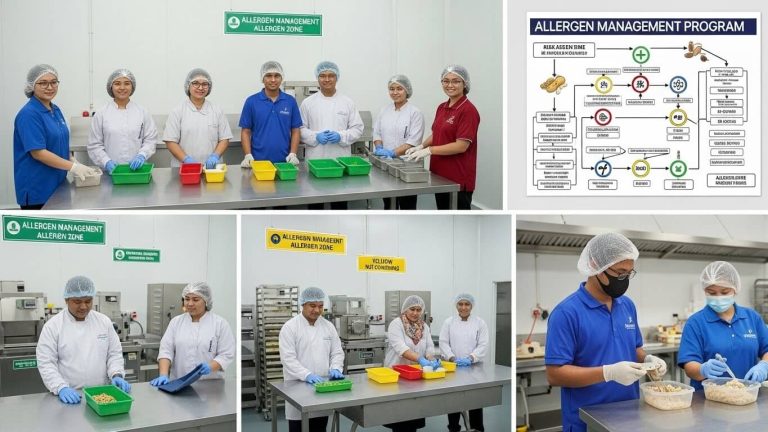
- Elevates allergen control from a general PRP to a dedicated, rigorous set of requirements, mandating a fully documented Allergen Management Program.
Integration of Quality Aspects
- Recognizes that quality failures (like incorrect labeling or shelf-life issues) can lead to food safety incidents, requiring their integration into the FSMS where relevant.
Staying current with these updates is not optional—it is required for all certification audits after the transition deadline. For a detailed, side-by-side comparison of Version 5.1 and the new Version 6, read our dedicated guide on FSSC 22000 Version 6 updates.