
If you are responsible for halal certification in your company, you have likely encountered MYeHALAL and MyHALALINGREDIENTS. These two platforms are the backbone of Malaysia’s digital halal certification ecosystem, yet they remain a source of frustration for many organizations.
Application rejections. Repeated system queries. Confusing ingredient verification processes. Sound familiar?
You are not alone. Since the implementation of the Manual Procedure for Malaysia Halal Certification (MPPHM 2020) , companies across Malaysia have struggled to adapt to the digital requirements. The good news? With the right understanding and approach, you can master these systems and transform your halal certification process from a headache into a smooth, efficient operation.
In this comprehensive guide, we will walk you through everything you need to know about MYeHALAL and MyHALALINGREDIENTS, the most common mistakes companies make, and how to ensure your applications get approved the first time.
What is MYeHALAL? Understanding Malaysia’s Halal Certification Portal
MYeHALAL (Malaysia Halal Certification System) is the official online portal managed by JAKIM (Department of Islamic Development Malaysia) for all halal certification matters. It serves as the central platform where companies:
Submit new halal certification applications
Apply for certification renewal
Request scheme variations (e.g., adding new products)
Upload supporting documents
Track application status in real-time
Download active halal certificates
Respond to officer queries
The system covers multiple certification schemes, including:
Food Premise (PM) – For restaurants, cafeterias, catering services, and central kitchens
Food Product (PR) – For manufactured food and beverage products
Consumer Goods – For cosmetics, pharmaceuticals, and personal care products
Logistics – For warehousing and transportation services
What is MyHALALINGREDIENTS? The Ingredient Verification Database
MyHALALINGREDIENTS is often misunderstood. Many companies treat it as a separate, optional tool—but this is a critical mistake. Many Halal executives and Halal supervisors are not aware of this new tools despite that it is compulsory to use effective 15th of August 2025.
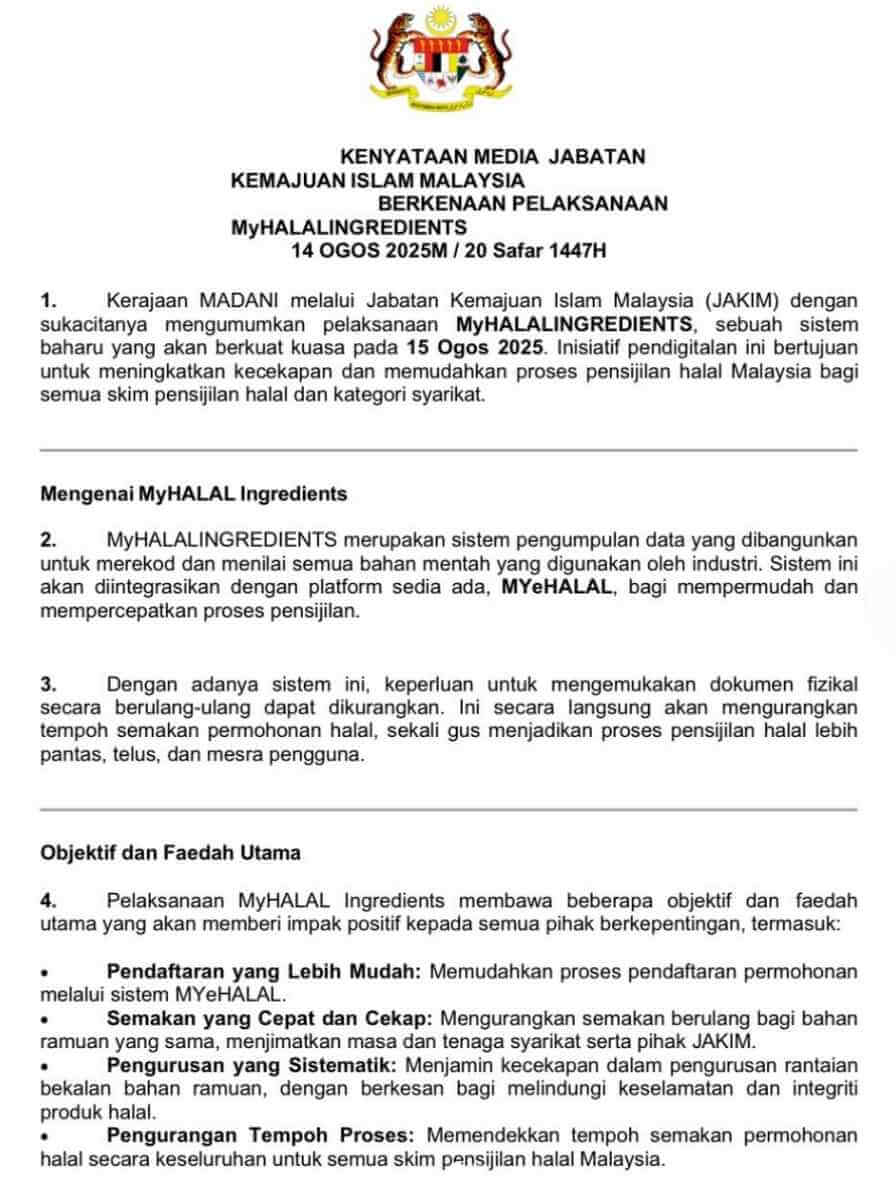
MyHALALINGREDIENT is actually the ingredient verification backbone that supports MYeHALAL applications. It is a comprehensive database where companies must:
Register all raw materials and ingredients used in production
Verify the halal status of each ingredient
Link ingredients to specific products in MYeHALAL applications
Upload supporting documents (certificates, specifications, flow charts)
Screen potential suppliers before purchasing
Think of it this way: MYeHALAL is where you submit your application, but MyHALALINGREDIENT is where you prove that your ingredients are halal. The two systems are designed to work together seamlessly—but only if you use them correctly.
Why Companies Struggle with MYeHALAL and MyHALALINGREDIENT
Despite the digitalization, JAKIM continues to receive thousands of incomplete or incorrect applications. Based on our experience training hundreds of halal executives, here are the most common pain points:
1. Incorrect Data Entry
The most frequent cause of application rejection is simple data entry errors. Misspelled product names, incorrect HS codes, mismatched company information—these small mistakes trigger automatic queries from the system.
2. Incomplete Documentation
Many companies upload documents without checking JAKIM’s specific requirements. For example, ingredient specifications must be on supplier letterhead, include manufacturer details, and show clear halal certification logos. Missing any of these elements means rejection.
3. Poor Ingredient Control
The biggest mistake? Treating MyHALALINGREDIENT as an afterthought. Companies often start building their ingredient database only AFTER receiving a query from JAKIM. By then, it is often too late.
4. Lack of Understanding of System Integration
Many users do not understand how MyHALALINGREDIENT feeds into MYeHALAL applications. They enter ingredients in one system but fail to properly link them to products in the other.
5. Ignoring MPPHM 2020 Requirements
MPPHM 2020 introduced strict new requirements for ingredient control, documentation, and internal halal governance. Companies that haven’t updated their processes to match these requirements face repeated rejections.
Step-by-Step: How to Successfully Navigate MYeHALAL
Step 1: Account Registration and Company Profile Setup
Before submitting any application, ensure your company profile is complete and accurate. This includes:
Correct company registration number (SSM/ROC)
Accurate business address and contact information
Designation of authorized representatives
Upload of company profile documents (PBT license, FOSIM domestic declaration for food premise, etc)
- Choose you business size category. Do not mistake Micro, Small, Medium and large size business. There is huge difference in requirements if you mistakenly choose wrong category.
💡Pro Tip: Double-check every field. Even a single digit wrong in your registration number will delay your application by months.
Step 2: Understand Your Certification Scheme
Are you applying for Food Premise (PM) or Food Product (PR)? Each scheme has different requirements:
PM schemes focus on services and food handling processes such as Restaurants, cafe catering, kiosk, food courts etc.
PR schemes require detailed ingredient breakdowns and product specifications mainly for food manufacturer and central kitchens.
Selecting the wrong scheme is a common mistake that requires starting over from scratch.
Step 3: Build Your Raw Ingredient Masterlist in MyHALALINGREDIENTS
Before starting your MYeHALAL application, spend time in MyHALALINGREDIENTS. Your masterlist should include:
Every raw material used in production
Supplier details and halal certificates
Supporting documents (SDS, specifications, flow charts)
Verification status of each ingredient
This step cannot be skipped. JAKIM officers will check your ingredient database before approving any application.
Step 4: Submit Your MYeHALAL Application
With your ingredient masterlist complete, you can now submit your application through MYeHALAL. The system will pull ingredient data directly from MyHALALINGREDIENTS, reducing manual entry errors.
🔻Download Halal Template (Ingredients Masterlist (MS Excel))🔻
Step 5: Prepare Supporting Documents
Documents must be:
Clear and legible
- Properly named according to JAKIM conventions
Current (not expired)
Common documents include:
Company profile and SSM
Site layout and floor plan
Flow chart of production process
List of products with ingredients
Halal certificates for all suppliers
Step 6: Track and Respond to Queries
After submission, monitor your application status through the MYeHALAL dashboard. If JAKIM raises queries:
Respond promptly (delays can cancel applications)
Address every point raised
Upload corrected documents immediately
Use the query response system correctly
Step 7: Certificate Management
Once approved, your halal certificate will be available for download through MYeHALAL. Track renewal dates and start the renewal process at least three months before expiry.
Common MYeHALAL Mistakes and How to Avoid Them
| Mistake | Consequence | Solution |
|---|---|---|
| Incomplete ingredient masterlist | Application rejected | Build masterlist before starting application |
| Expired supplier certificates | Queries raised | Verify all supplier docs are current |
| Ingredients and product list not sync | Queries raised | Build masterlist before starting application |
| Missing supporting documents | Delayed processing | Use JAKIM checklist before upload |
| Ignoring system notifications | Application lapses | Check dashboard weekly |
The Role of MyHALALINGREDIENTS in Halal Supply Chain Management
Beyond certification, MyHALALINGREDIENTS is a powerful tool for ongoing halal compliance. Smart companies use it for:
Supplier Screening
Before approving a new supplier, check their ingredients against the MyHALALINGREDIENTS database. This prevents non-halal materials from entering your supply chain.
New Product Development
When developing new products, use MyHALALINGREDIENTS to verify potential ingredients before finalizing formulations.
Internal Audits
Regularly review your ingredient masterlist to ensure all supplier certificates remain valid and all documents are current.
Audit Preparation
When JAKIM auditors visit, your MyHALALINGREDIENTS database serves as proof of your ingredient control system.
Building Your Internal Halal Team: Beyond the Systems
Mastering MYeHALAL and MyHALALINGREDIENTS is essential, but technology alone does not guarantee halal compliance. To build a robust halal management system, your organization needs:
Halal-Competent Staff
MPPHM 2020 requires that personnel involved in halal certification receive appropriate training. This includes:
Halal Awareness Training for all staff
Halal Competency Training for key personnel
Specialized training for Halal Executives and Internal Auditors
An Internal Halal Control System (IHCS)
A documented system that ensures:
Clear roles and responsibilities
Documented procedures for ingredient verification
Internal audit processes
Management review and continuous improvement
Regular Internal Audits
Conduct internal audits at least annually to identify gaps before JAKIM finds them.
Why Hands-On Training Makes the Difference
Reading guides (like this one) is helpful, but nothing replaces hands-on practice with the actual systems. The difference between knowing about MYeHALAL and knowing how to use MYeHALAL is the difference between application rejection and approval.
Effective training should include:
Live system walkthroughs with real examples
Hands-on data entry exercises
Practice handling common system queries
Real-case analysis of successful and rejected applications
Troubleshooting sessions for specific challenges
Take the Next Step: Master MYeHALAL with Expert Guidance
At Al Barakah Training Solution, we have trained hundreds of halal executives, QA teams, and procurement officers to master MYeHALAL and MyHALALINGREDIENT. Our 1-Day Hands-On Workshop is designed to transform your team from hesitant users into confident system navigators.
In our workshop, participants will:
Navigate MYeHALAL and MyHALALINGREDIENT with confidence
Develop a JAKIM-compliant Raw Ingredient Masterlist
Submit error-free applications for Food Premise and Food Product schemes
Respond effectively to system queries
Reduce certification delays and rejection rates
Who should attend:
Halal Executives and Supervisors
QA/QC Teams
Procurement and Purchasing Officers
Production and Operations Staff
SME Owners managing their own certification
[👉 Register for MYeHALAL & MyHALALINGREDIENTS Training Workshop]
Strengthen Your Halal Team with These Complementary Courses
One workshop is powerful. A complete training roadmap transforms your organization. Consider these additional programs to build a fully competent halal team:
| Course | Best For |
|---|---|
| Halal Awareness Training | All employees (mandatory under MPPHM 2020) |
| Halal Competency Training | Key personnel involved in halal execution |
| Halal Assurance System (HAS) Training | Building comprehensive management systems |
| Implementation of Halal Internal Audit | Internal auditors and IHC members |
| Halal Executive Refresher Training | Experienced executives needing updates |
[👉 Explore All Halal Training Courses]
Conclusion: From Confusion to Confidence
MYeHALAL and MyHALALINGREDIENT are not obstacles—they are tools designed to help you maintain halal integrity throughout your operations. When you understand how to use them correctly, they become your strongest allies in achieving and maintaining halal certification.
Stop struggling with queries and rejections. Invest in proper training, build your internal capabilities, and transform your halal certification process from a source of stress into a competitive advantage.
Ready to master MYeHALAL? Join our next workshop and experience the difference that hands-on training makes.