
In Malaysia, halal certificate withdrawal removes certification within the affected scope. Management needs to establish which products, premises and claims are affected before making the next production or sales decision. A withdrawal can stop permitted halal claims and bring recall instructions, corrective work and difficult conversations with buyers. The consequences depend on the authority’s notice and the scope of certification.
The cost can travel well beyond the certificate holder. A central kitchen supplies outlets; a manufacturer supplies distributors; packaging and online listings carry claims that customers rely on. Weak control at one point can create work across that network.
The Malaysian cases below show four withdrawal incidents and a separate suspension comparison. They also show why later outcomes matter. A historical headline is not evidence of a company’s current status, and certificate action does not by itself prove criminal guilt or that every product contains non-halal ingredients.
Withdrawal, suspension and expiry are different
Before acting on a circulating report, identify the decision it actually describes.
| Status or event | What management needs to establish |
|---|---|
| Withdrawal (ditarik balik) | Which certificate and scope have been withdrawn, what claims must stop, and what further action the authority requires. |
| Suspension (digantung) | Which certification is temporarily suspended, the restrictions during suspension, and the authority’s conditions for its next decision. Suspension is not a final finding of criminal guilt. |
| Expiry or non-renewal | Whether certification remains valid. Expiry alone does not establish misconduct or an enforcement withdrawal. |
| Investigation, inspection or seizure | What the authority has actually found or ordered. These events do not, by themselves, establish that an existing certificate has been withdrawn. |
A non-conformity, or ketidakakuran, also needs its proper context. A document gap, a hygiene finding and a serious Shariah non-conformity do not automatically receive the same action.
For present-day domestic certification, the reference is the Manual Procedure for Malaysia Halal Certification (Domestic) 2020, amended by Circular 1/2026, effective 1 April 2026. Procedures 31–33 address monitoring, non-conformities and enforcement. The action pathways below explain what management needs to distinguish before responding.
These current provisions guide today’s controls; they are not a retrospective verdict on events in 2014 or 2015. For the broader certification framework, see our guide to halal certification requirements and application routes.
What action can follow halal non-compliance?
The current domestic manual separates classification from action. Procedure 32 classifies non-conformities as minor (kecil), major (besar) or serious (serius). Under 33(1), the competent authority determines action against non-compliant holders of Malaysian Halal Certification (SPHM).
33(2) lists the available measures: a non-conformity notice, suspension, withdrawal, MYeHALAL-account freezing and public notification of company status. Not every measure applies automatically to every finding. 33(1)–(2), printed page 77 / PDF page 83.
| Finding | Action under procedure 33 | What management must not overlook |
|---|---|---|
| Minor — 33(3) | Monitoring and non-conformity notices, with a warning to correct immediately, within 14 days or within another period considered reasonable. Follow-up monitoring may be needed. Failure to correct within the directed period brings a suspension/withdrawal notice; the escalation pathway includes immediate suspension and panel determination of SPHM status. | Do not assume every initial minor finding immediately suspends certification, or that every warning grants 14 days. Correct within the period actually directed. |
| Major — 33(4) | Monitoring, non-conformity and suspension/withdrawal notices, with immediate suspension. The correction warning also allows immediate correction, 14 days or another period considered reasonable. The suspension report goes to the Halal Certification Panel to determine whether follow-up monitoring is needed, SPHM is returned or SPHM is withdrawn. | Time allowed for corrective work does not postpone suspension. Submitting evidence does not itself restore certification. |
| Serious — 33(5) | Monitoring and withdrawal notices, with immediate withdrawal. The withdrawal report goes to the Halal Certification Panel for a final decision. | No 14-day corrective grace period is specified in this subclause. Immediate withdrawal does not wait for that reporting stage. |
Sources: 33(3)(a)–(c), printed page 77 / PDF page 83; 33(3)(d)–(g) and 33(4), printed page 78 / PDF page 84; 33(5), actions on printed page 79 / PDF page 85.
A serious central-kitchen withdrawal reaches the related food premises. Under 33(5)(e), when a central kitchen’s SPHM is withdrawn because of a serious non-conformity, all related food premises must also have their SPHM withdrawn. For an operator, that means the certification consequence extends beyond the production kitchen to the related premises serving customers.
It is not a rule that every ordinary supplier issue cancels every customer’s certificate. 33(5)(e), printed page 79 / PDF page 85.
Under 33(3)(g), 33(4)(e) and 33(5)(d), the authority may list the suspended or withdrawn company on the Official Halal Malaysia Portal and/or freeze its MYeHALAL account for at least three months. These are discretionary measures.
The minimum duration applies to an account freeze if imposed—not an automatic three-month reapplication ban or a promise of restoration after three months. Minor and major provisions, PDF page 84; serious provision, PDF page 85.
Under 33(6), suspended or withdrawn holders must not use the Malaysian halal logo or any halal expression or label. Covering the logo while continuing the same halal claim on a menu or online is not an adequate response. Establish the exact holder and operation covered by the decision, then address the prohibited claims across the relevant channels.
Under 33(7), the authority may pursue further action under applicable legislation and regulations if it considers this necessary. This is not an automatic criminal finding, prosecution or cancellation of a separate business licence. 33(6)–(7), printed page 79 / PDF page 85.
These current pathways do not assign a non-conformity category retrospectively to the historical cases below. Corrective work, appeal, reapplication and permission to resume certified-halal claims remain separate matters.
An October 2024 report citing JAKIM’s Halal Management Division director referred to 3,068 Malaysian halal certificates withdrawn. The report did not specify the starting date of the tally or a reason-by-reason breakdown. The figure counts certificates, not companies or findings that every affected product was unsafe or prohibited.
Real withdrawal cases and what happened afterwards
Secret Recipe, 2015: a central-kitchen issue reached the wider chain
The withdrawal involving Secret Recipe Manufacturing Sdn Bhd took effect on 7 May 2015. In its 26 May 2015 report on the withdrawal, The Edge reproduced JAKIM’s explanation that the issues concerned cleanliness and good manufacturing practices. JAKIM expressly said the action had nothing to do with non-halal ingredients.
An early FMT report also described the Taman Mayang cleanliness issue; the effective date above follows the subsequent reporting of JAKIM’s explanation.
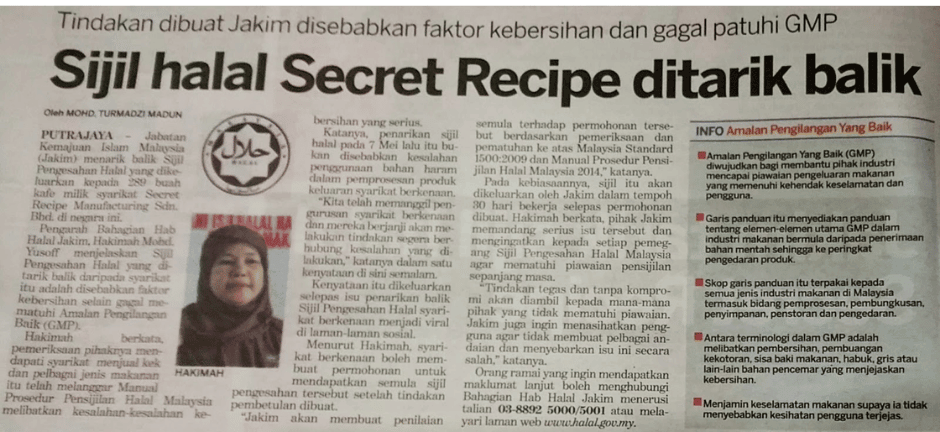
That distinction changes the lesson. Reading the incident simply as an ingredient controversy would miss the operational issue: hygiene and manufacturing controls at a shared production point can affect confidence in the network it supplies.
The Edge’s 2 July 2015 follow-up on renewed certification reported a minister’s explanation that the central kitchen supplied all 297 Malaysian outlets at the time, affecting the chain. This was a description of the historical supply network, not a report of 297 outlet closures or separate certificate withdrawals at every outlet.
The same follow-up quoted the company’s announcement that it was again certified halal after renovation and upgrading at its Taman Mayang central kitchen and new Kota Damansara plant. The company also described establishing a quality, hygiene and halal-compliance team. That reported recovery belongs alongside the withdrawal, rather than being left out of the story.
For a central-kitchen operator, the practical lesson is to assess how production changes, maintenance and sanitation decisions affect dependent outlets. Management should be able to identify what each outlet receives, which controls govern release and who can stop a change that has not been reviewed.
These are recommendations drawn from the dependency the case illustrates, not claims about undisclosed failures at individual outlets.
Alagappa, 2024: corrective-action closure and later certification
In March 2024, Alagappa Flour Mills Sdn Bhd had its halal certification withdrawn by Penang’s religious authority, Jabatan Hal Ehwal Agama Islam Pulau Pinang, for non-compliance with the Manual Procedure for Malaysia Halal Certification (Domestic) 2020.
JAKIM’s clarification, republished by Sebenarnya.my, stated that the halal status of products manufactured before 12 March 2024 was unaffected. That manufacture cutoff matters to buyers assessing existing stock; it is not a blanket retrospective prohibition on every product.
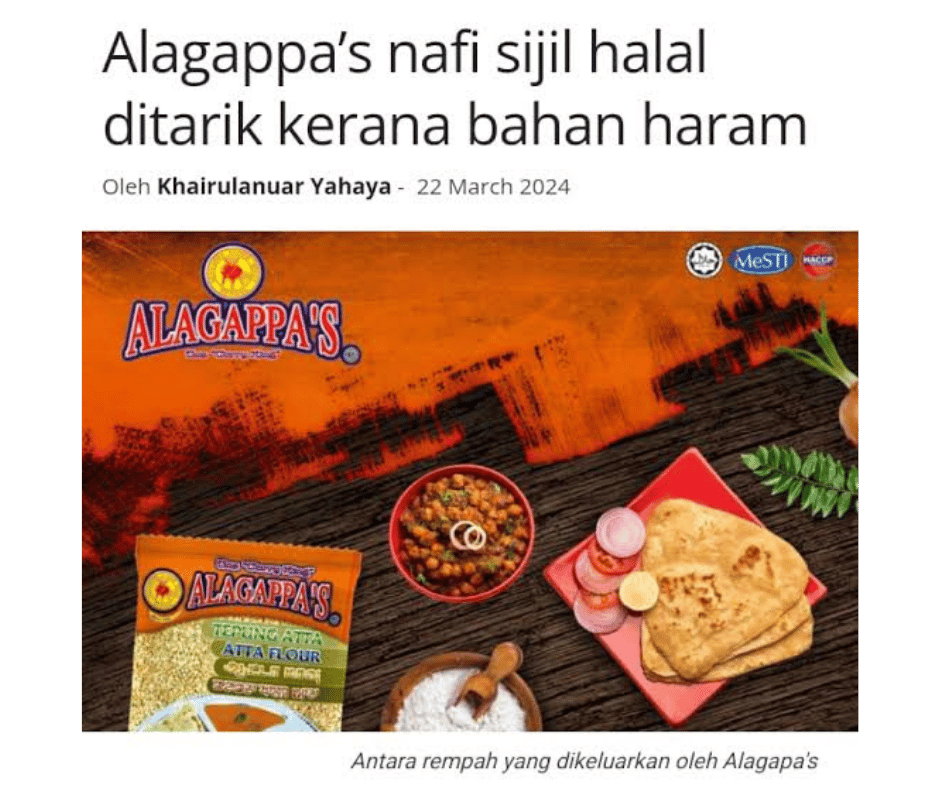
In Astro Awani’s 23 March 2024 report, the company described an initial suspension over non-critical technical issues. It said staffing constraints had prevented satisfactory corrective work and closure of non-conformity reports within the allotted period, leading to withdrawal.
The company also said the matter did not involve prohibited-ingredient contamination or hygiene. This was the company’s explanation; the authority’s stated reason was the broader procedural non-compliance.
The later evidence is important. An official Halal Malaysia directory record checked on 28 October 2026 listed Alagappa and certified products with expiry dates in 2028. Those product listings do not establish the exact date of restoration in 2024 or show that today’s scope is identical to the withdrawn scope.
They do rule out treating the March headline alone as evidence of continuing withdrawal.
For manufacturers, the lesson is to give corrective actions named owners, enough staff and a management escalation route when evidence is not ready for review. For distributors and food businesses using a manufacturer’s products, purchasing and quality teams should match the actual product and manufacture date to the relevant certificate scope and authority instructions before deciding what to hold or replace.
A supplier-level problem needs a stock-specific decision, not an assumption that every downstream certificate is automatically affected.
Coffee & Biscuits Factory, 2026: cleaning tools, recall instructions and subsequent evidence
The joint Melaka incident shows why a halal-control review cannot end with the recipe.
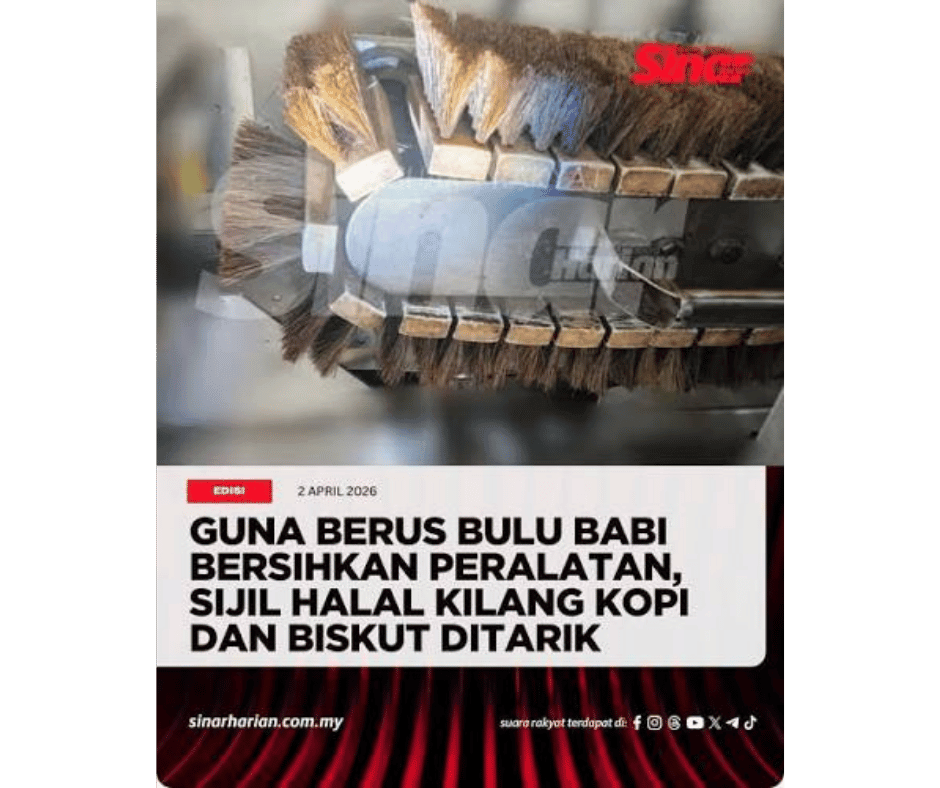
In its 3 April 2026 report naming the affected manufacturers, FMT identified Heng Loong Coffee Sdn Bhd, in Taman Tanjung Minyak, and Tian Hup Seng Biscuits Factory Sdn Bhd, in Taman Telok Mas. Reports described cleaning brushes believed to be made from pig bristles; Bernama’s Malay-language report of 4 April 2026 described brushes with characteristics of pig bristles.
These attributed descriptions should not be turned into a claim that every finished product was laboratory-confirmed contaminated.
Bernama’s 4 April 2026 account of JAKIM’s statement confirmed that the Melaka Islamic Religious Department, JAIM, had taken the withdrawal action. The companies were instructed to stop using the Malaysian halal logo, recall affected products and implement comprehensive corrective measures.
FMT also reported that authority-required sertu, or ritual cleansing, had to take place before reapplication. Sinar Harian’s reporting of the same action corroborated the logo-cessation, affected-product withdrawal and corrective-measure instructions, including sertu before reapplication could be considered.
The applicable authority’s directions govern that process; ordinary cleaning advice is not a substitute. The reported recall and logo restrictions were concrete business consequences. They required attention beyond the factory floor because products and claims had already entered the market.
There was a separate licensing decision. On 6 April 2026, Bernama reported that the municipal business licences would not be revoked, because no breach of the Melaka Historic City Council’s business-licence conditions had been reported. That distinction does not give blanket permission to continue every activity.
It shows that halal certification and a municipal business licence are different decisions.
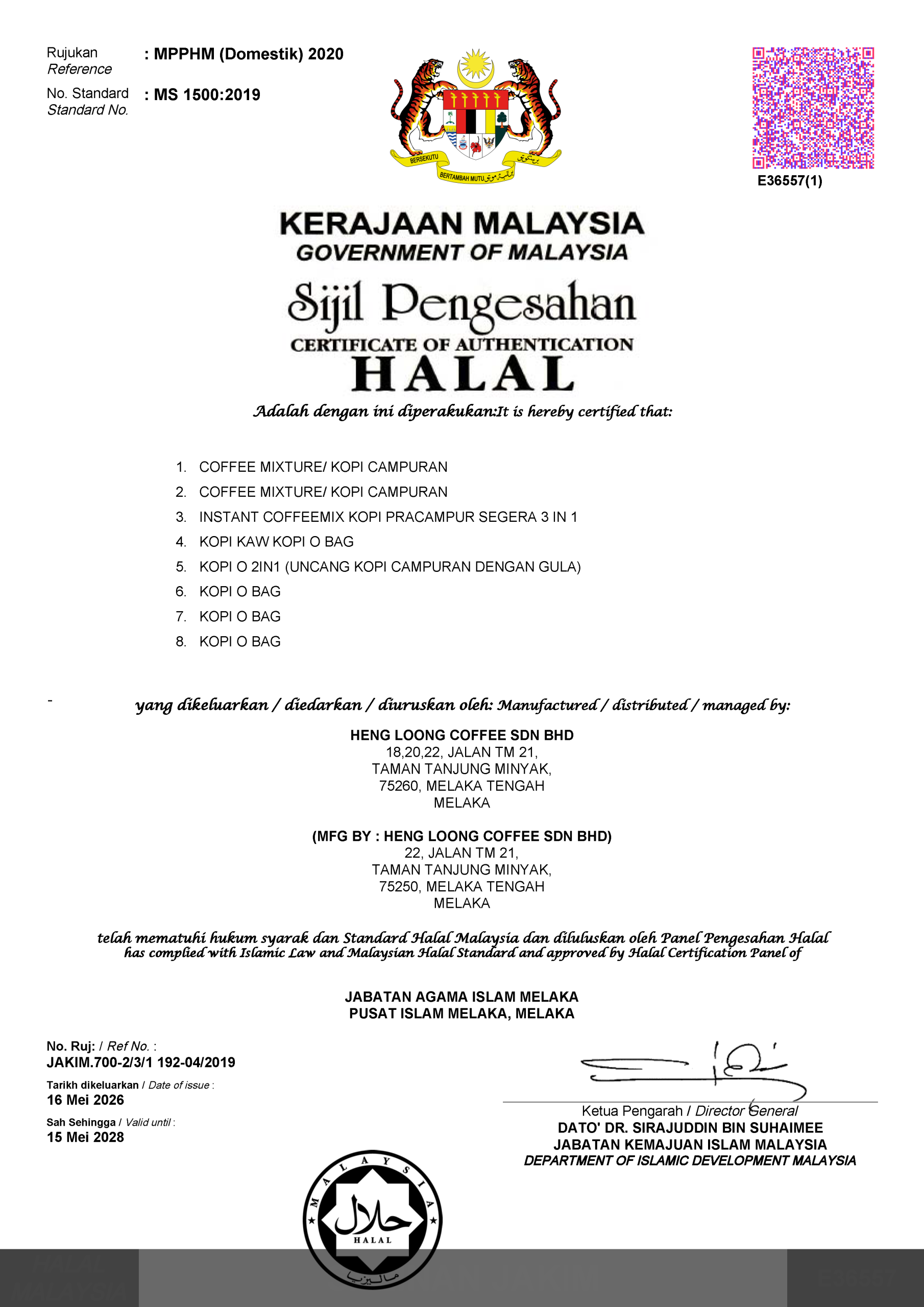
There is also material later evidence. Heng Loong Coffee subsequently published a certificate image dated 16 May 2026, with validity printed until 15 May 2028. This is a company-published image, not an independently authenticated live-registry result. Buyers should verify the current official record and the exact products and premises covered.
It would be misleading to use the April reports alone to describe the coffee company as currently revoked. A later confirmed outcome for the biscuit company was not established in the sources reviewed; that gap does not prove continuing revocation either.
Names matter too. AFP’s 10 April 2026 fact-check of the Melaka incident distinguished the affected biscuit manufacturer from the unrelated Hup Seng cream-cracker brand. Shortening the affected company’s name risks directing an allegation at a different business.
For managers, the control lesson concerns equipment purchasing as well as ingredients: cleaning brushes, maintenance materials and contractor tools need appropriate review. Someone must own that decision before an item reaches production. This does not mean every hygiene problem requires sertu, or that the reports establish criminal guilt.
Sri Manja Hotel, 2026: rejected withdrawal appeal and reported reapplication
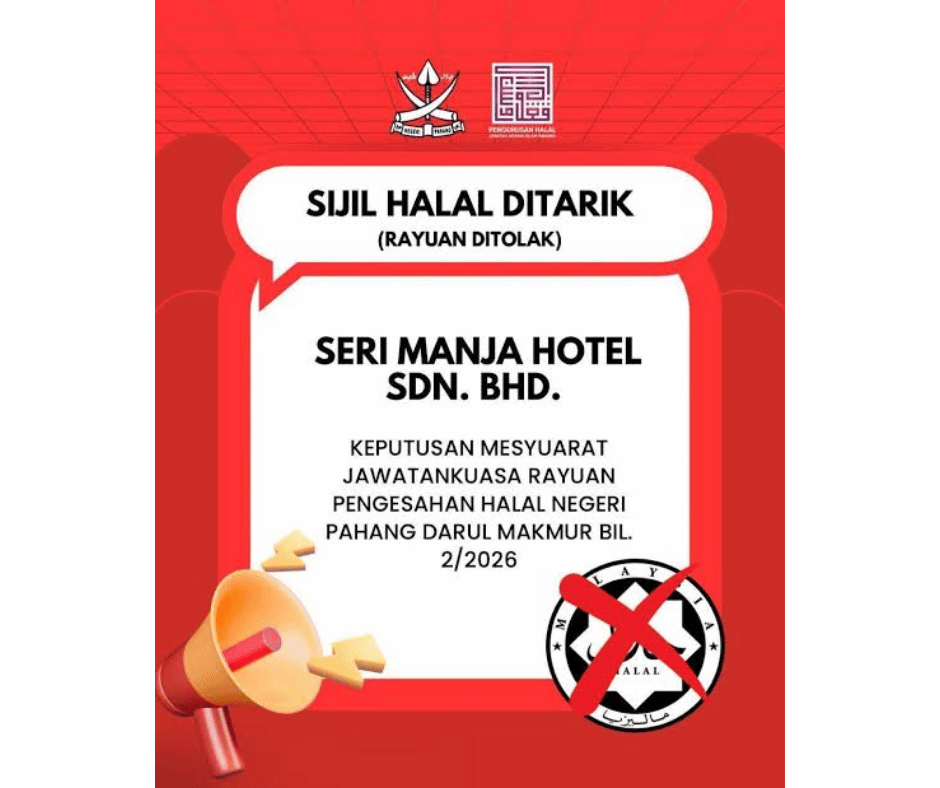
A government republication marked 18 June 2026 reproduced Jabatan Agama Islam Pahang (JAIP)‘s notice that an appeal against the withdrawal of halal certification belonging to Seri Manja Hotel Sdn Bhd had been rejected.
The publication date does not establish the original withdrawal date. The notice concerns a withdrawal appeal, rather than ordinary certificate expiry, but does not provide a detailed inspection reason.
In its response reported on 19 June 2026 by MalaysiaGazette and Siakap Keli, Sri Manja Hotel / Sri Manja Boutique Hotel, Kuantan, said the matter concerned compliance and hygiene improvements, that corrective steps had been taken and that it was applying again. That explanation belongs to the hotel.
Reapplication is not restoration: these June reports do not establish present certification status or the exact certified kitchen, restaurant or product scope. The action should not be extended to bedrooms or every hotel service.
For hotel management, the practical lesson is to track an appeal, corrective work and reapplication as separate tasks, with responsibility and evidence for each. Event organisers and catering buyers depend on the relevant food operation, not the hotel’s name alone.
Before confirming a supply arrangement or making a halal claim to guests, verify the current certificate for the kitchen or premises and the menu or product scope involved.
Cadbury 2014: suspension comparison, not a guilt finding
Cadbury’s experience is a useful comparison because suspension, test results and public reaction followed different timelines.
JAKIM’s statement dated 24 May 2014 suspended certification for two products, Cadbury Dairy Milk Hazelnut and Dairy Milk Roast Almond, following an initial Health Ministry finding. It was not a withdrawal covering every Cadbury product worldwide.
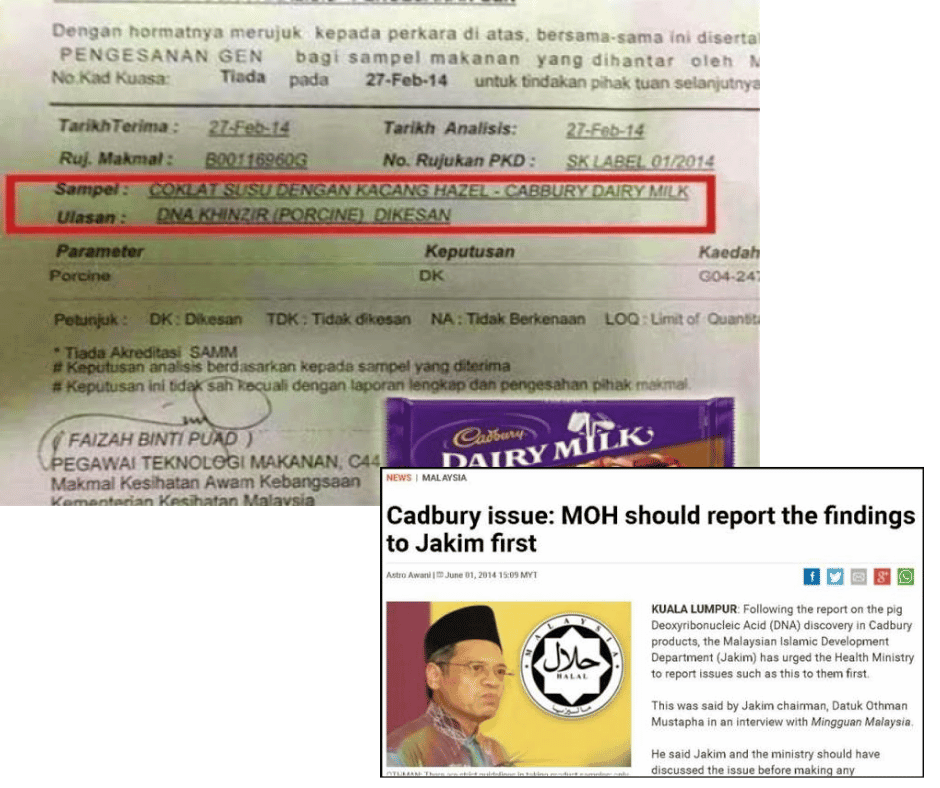
A ministerial statement dated 2 June 2014 concerning Cadbury Confectionary (M) Sdn. Bhd. reported that subsequent factory-sampled tests found no pig DNA. The BBC’s report of 2 June 2014 still described the suspension as awaiting review. Negative tests and formal return of certification were separate steps.
Later June reporting, archived on 10 June 2014, described certification being returned.
The BBC also reported a product recall and boycott calls continuing despite the new negative results. JAKIM’s later clarification about the recirculating Cadbury issue, which references monitoring in 2023, described both products as certified at the time of that clarification. It is not a live certificate-status check today.
The commercial lesson is about accurate communication and the persistence of an allegation. This comparison does not establish proven pork use, a conviction or a measured loss of sales.
Where the business cost travels
A withdrawal can interrupt the connection between what a business produces and what it is entitled to tell buyers. Management then has to reconcile physical stock with certificate scope, distribution records and public claims.
The cases establish specific actions, not a reliable ringgit estimate of damage. The table separates those facts from possible consequences an operator should plan for.
| Cost pathway | What the cases document | Possible operational or sales exposure, not measured case losses |
|---|---|---|
| Certificate and claims | Melaka manufacturers were told to cease the Malaysian halal logo. | Packaging, menus and digital listings may need review; buyers requiring valid certification may pause purchasing. |
| Stock and distribution | Affected-product recall was ordered in Melaka; the BBC reported Cadbury’s recall. | Retrieval, transport, stock reconciliation and returns handling can consume resources. |
| Shared production | Secret Recipe’s central-kitchen dependency was reported as affecting its chain. | Outlets or downstream customers may need supply decisions and verified explanations even when the issue starts upstream. |
| Corrective work | Corrective measures were directed in Melaka; Secret Recipe later announced upgrading and renewed certification. Alagappa attributed escalation to missed corrective-action closure and staffing constraints; Sri Manja reported corrective work and reapplication. | Management time, equipment review, training and follow-up checks may compete with routine operations. |
| Customer confidence | Cadbury boycott calls continued after new negative tests. | Sales teams may need repeated factual updates; old reports or mistaken identity can complicate reassurance. |
These sources do not establish particular retailers delisting products, cancelled contracts, export bans, lost market share or quantified revenue losses for the named businesses. Such outcomes should not be added simply because they sound plausible.
For your own business, trace the dependency rather than borrowing another company’s presumed loss. Which customers require current certification? Which outlet depends on which production site? Can the team identify affected stock without unnecessarily treating every batch as affected? The answers help management contain disruption while keeping claims accurate.
Control the whole supply chain, not just ingredients
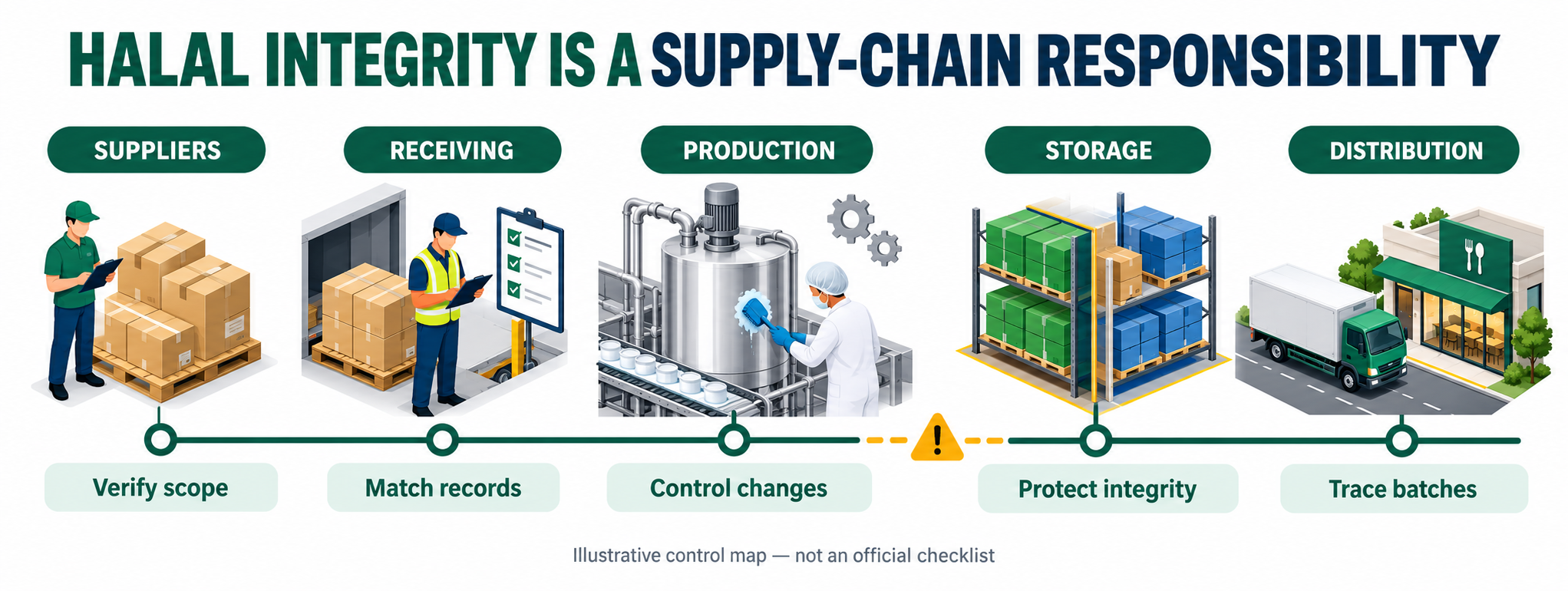
A supplier’s certificate is useful only when it matches the manufacturer, material and scope actually used. A purchasing substitution can break that link; an unreviewed cleaning tool can create a different risk even when the recipe has not changed.
The Malaysia Halal Management System 2020, especially printed pages 9–14, addresses risk controls, materials, traceability and system review. The following map translates those principles into practical evidence checks. The accountable roles are recommended assignments, not universal statutory job appointments.
| Control point | Evidence to retrieve | Accountable role | Escalation or control |
|---|---|---|---|
| Supplier and material approval | Actual manufacturer; product and premises scope; issuer and expiry; approved material masterlist and supporting evidence, including processing aids. | Purchasing with the halal lead. | Block unapproved substitutions. Review changes through the applicable notification or approval route. |
| Receiving and storage | Delivery and lot identifiers linked to approved items; condition, segregation and discrepancy records. | Receiving or warehouse lead. | Quarantine discrepancies pending review rather than release them on verbal assurance. |
| Production, central kitchen and cleaning tools | Material-to-batch links; approved tools; cleaning, maintenance and change records, including relevant contractor equipment. | Production and sanitation leads with halal review. | Assess tool or process changes and identify affected lines before use or release. |
| Packaging and claims | Authorised certification scope; approved artwork; packaging stock; website, marketplace and menu claims. | Quality assurance with marketing. | Stop prohibited halal expressions and labels as directed across the affected channels. |
| Distribution and recall | Dispatched batch, destination and quantity; returns and reconciliation records. | Logistics with sales. | Locate affected lots and coordinate any directed recall using verified scope. |
| Management review and change approval | Current masterlist; internal audit findings; corrective-action effectiveness; training responsibilities and review sign-off. | Management and the applicable halal governance roles. | Check that controls work in practice rather than closing findings through paperwork alone. |
Supporting evidence must suit the material and applicable requirements; not every material needs an identical type of certificate. For businesses required to implement a Halal Assurance System (HAS), MHMS section 5(9) specifies at least annual mock recalls.
Section 5(10) also requires at least annual HAS review with management involvement and written endorsement. Those HAS-specific requirements should not be presented as identical obligations for every enterprise.
A useful management test is to select one dispatched batch and retrieve its material, production and customer records. If the links cannot be recovered, investigate the gap before an actual recall makes retrieval urgent.
What to do after a suspension or withdrawal notice
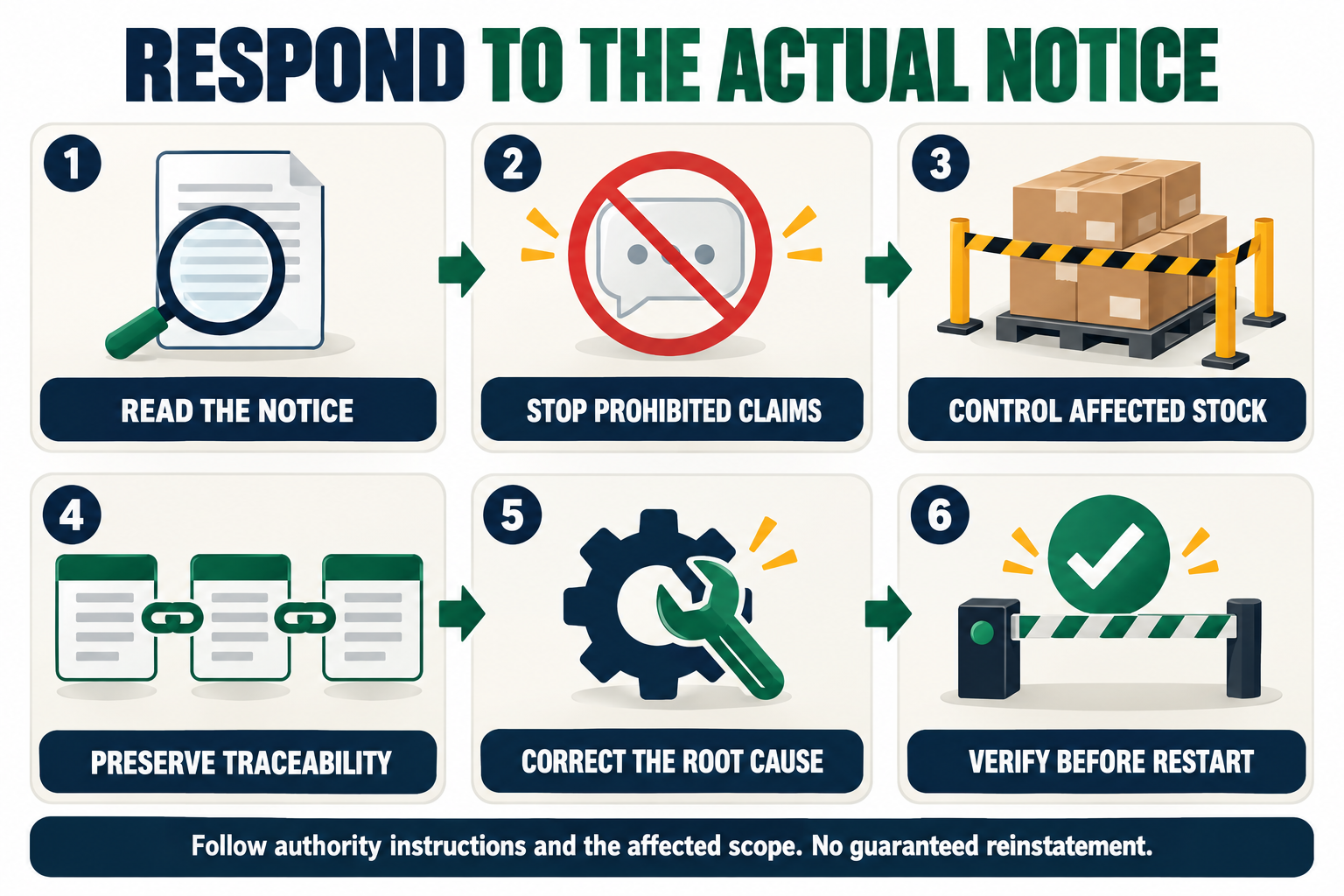
Use the authority’s actual notice as the starting point. This checklist is management guidance informed by MPPHM procedures 31–33 and MHMS traceability controls, not a universal legal procedure or promise of reinstatement.
- Confirm the decision and scope. Record the issuing authority, legal entity, premises, products or batches, stated non-conformity category, restrictions and deadlines. Record and comply with any certificate-return direction in the notice. Appoint one response lead so purchasing, production and sales work from the same verified information.
- Stop prohibited halal claims. Suspended or withdrawn holders must not use the Malaysian halal logo or any halal expression or label. Check the decision’s holder and operation scope, then review packaging, menus, websites, marketplace listings and customer materials—not only the physical pack.
- Contain stock and preserve evidence. Isolate affected or suspect stock as appropriate, retain relevant records and samples, and map distribution. Do not destroy evidence or assume every product is affected without checking scope.
- Coordinate with the issuing authority. Cooperate with inspection and follow its recall, testing, cleansing and communication directions. Give retailers and customers factual, scope-specific information and update it when the verified position changes.
- Correct the cause and demonstrate effectiveness. Establish why the control failed, implement corrective action and show that it works. Where sertu is required, follow the authority-guided requirements. A completed form alone does not demonstrate that the problem cannot recur.
- Meet the actual response period. Submit the required evidence and facilitate follow-up within the period directed. The correction windows for minor and major findings are not a universal grace period and do not postpone immediate suspension or withdrawal under the applicable pathway.
- Wait for the appropriate authority decision before resuming certified-halal claims. Check the restored or approved scope. Sending a response, completing training or receiving a consultant’s assurance does not restore certification.
Keep the cause investigation focused on the failed control and the evidence needed to prevent recurrence. Detailed root-cause analysis is a separate task; immediate containment and accurate communication should not wait for a lengthy report.
Prevention is a management system, not a one-off certificate
Assign capability where decisions are made. At Al Barakah Training Solution, relevant training can support different responsibilities without treating attendance as a guarantee against enforcement.
Frontline employees handling materials, storage or cleaning equipment need to recognise an unapproved change and know whom to alert. Halal Awareness Training is a relevant starting point for that understanding.
The person coordinating routine halal controls needs a different depth of knowledge. Halal Executive Training can support learning about operational responsibilities and system coordination. Where an internal halal committee is required, Halal Competency Training can support committee capability; ask our team about current programme availability before planning attendance.
Select learning against the applicable scheme and the participant’s role, rather than assuming all programme names or awards are equivalent.
Teams responsible for checking controls can consider internal halal audit training to strengthen how they identify weaknesses and examine corrective-action evidence. Management still has to resource those controls and act on the findings.
Common questions
Does withdrawal mean all products contain non-halal ingredients?
No. JAKIM’s explanation of the Secret Recipe incident expressly distinguished cleanliness and GMP issues from non-halal ingredients. Read the stated finding and affected scope; do not infer contamination from the word “withdrawal”.
Is the business licence automatically cancelled?
No automatic link should be assumed. In the Melaka incident, the municipal licences were not to be revoked because no municipal licence-condition breach had been reported. Other permissions and restrictions still need separate checking.
Can a business use the halal logo during suspension?
No. Under procedure 33(6), printed page 79 / PDF page 85, suspended or withdrawn holders must not use the Malaysian halal logo or any halal expression or label. Verify the holder and operation covered by the notice and check every channel carrying the claim; replacing the logo with a written halal claim is not a workaround.
Does an old news article prove current certificate status?
No. Check the date, legal entity, premises, product scope and subsequent evidence against the current official record. A company-hosted certificate image is useful evidence to examine, but is not a substitute for that verification.
Can certification return after corrective work?
A later return is possible, as the reported Secret Recipe outcome illustrates. It depends on the authority’s assessment and applicable process. Corrective work, reapplication or training does not guarantee approval or a particular timeline.
The practical objective is to keep purchasing, production, distribution and public claims consistent with the evidence. If your team cannot confidently connect those records, speak with us about halal gap assessment and implementation support.
Share your operation type, certification scheme and the control problem you need to address so we can discuss suitable training, coaching or consulting. Any certification decision remains with the relevant authority.