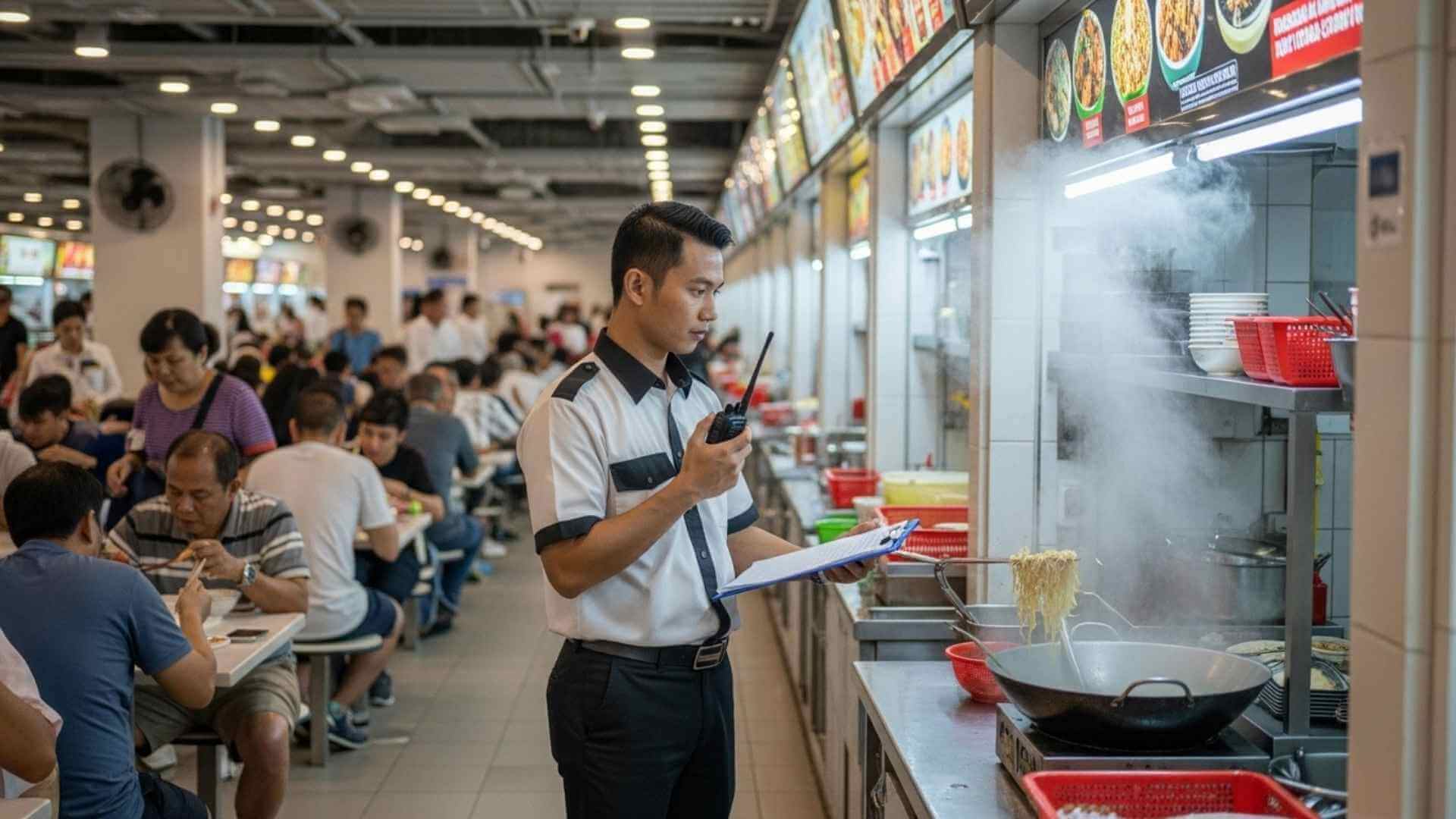
A tourist snaps a photo of their vibrant nasi lemak at a bustling mall food court in Kuala Lumpur. A family shares a meal at a PLUS R&R during their road trip to Penang. A local enjoys supper at a Majlis Bandaraya Petaling Jaya (MBPJ) hawker centre.
These scenes are the heartbeat of Malaysian daily life and a cornerstone of our tourism identity. But behind every thriving food court lies a hidden, multiplied risk: a single food safety failure can cascade across a dozen stalls, sickening hundreds and making national headlines.
For the food court manager (of a mall, local council, or PLUS highway), your duty extends beyond collecting rent. You are the guardian of a public health node. For the individual stall vendor, your compliance is your license to operate in this lucrative, high-traffic environment.
This guide is the definitive playbook for navigating the complex, high-stakes world of Malaysian food court and R&R food safety. We provide the actionable framework to protect your customers, your business, and something even larger: Malaysia’s reputation as a safe and premier culinary destination.

The Unique, Multiplied Risk of the Food Court Model
A standalone restaurant controls its own destiny. A food court operates as a micro-ecosystem of risk. Here, failure is contagious.
The “Domino Effect” of Contamination:
One vendor’s improper pest control invites infestations that spread through shared walls and ceilings. One stall’s poor waste management attracts flies that visit neighbouring stalls. A single vendor’s employee with poor hand hygiene can handle the cutlery used by hundreds.
High-Volume, High-Vulnerability:
Food courts and R&Rs serve thousands of people daily from diverse age groups and health statuses. This volume turns a minor lapse into a major outbreak with astonishing speed.
The Tourist Dimension: A National Reputation at Stake:
Food courts and R&Rs are where tourism meets daily life. An international visitor falling ill from food poisoning doesn’t just blame the stall—they share stories that tarnish “Malaysian food” globally. In the age of viral social media and travel review sites like TripAdvisor, a single documented outbreak at a popular mall food court or a major PLUS R&R can deter future tourists and become a national public relations crisis. Your food safety protocol is, indirectly, a protocol for protecting Malaysia’s brand.
The 3-Party Accountability Chain (Who is Really Responsible?)
Understanding this chain is critical, as liability flows upwards when failures occur.
1.The Vendor/Tenant (The First Line)
The individual stall operator is directly responsible for their stall’s daily Good Hygiene Practices (GHP), Halal integrity (if claimed), staff training, and ingredient safety. They are the first point of failure—or defence.
2.The Food Court Management (The Critical Enforcer)
This is the mall management (e.g., Suria KLCC, AEON), local council (e.g., DBKL, MBPJ), or concessionaire (e.g., PLUS R&R operator). Your legal and operational duty is to set, audit, and enforce standards across all tenants. The Ministry of Health (MOH) and local council health officers will hold YOU, the management, primarily accountable for systemic failures across the premises.
3.The Local Authority & MOH (The Ultimate Judge)
They license the entire operation. Their audits are unforgiving, and their power to issue closure orders is absolute. Their focus is on Management’s control systems.
The Non-Negotiable Vendor Compliance Checklist (For Stall Operators)
As a vendor, your survival depends on exceeding these basics. Treat this as your daily operating creed.
The Documentation Wall:
- Your valid business license, current food handler certificates for ALL staff, and JAKIM Halal certificate (if applicable) must be visibly and prominently displayed. This is non-negotiable for audits and public trust.
Stall-Specific GHP Mastery:
- Zero Cross-Contamination: Strict separation of raw and ready-to-eat foods within your confined stall space. Use colour-coded chopping boards and utensils.
- Temperature Warfare: Your hot-holding units (bain-marie) must keep food above 60°C during all operating hours. Your refrigerators must be at or below 5°C. Keep daily logs.
- Waste Within Borders: Manage your stall’s waste immediately. Do not let bags pile up, attracting pests that will plague your neighbors.
Clarifying Shared System Responsibilities:
- Understand and comply with management’s schedule for shared exhaust hood cleaning, central grease trap maintenance, and common waste collection points. Your stall’s failure here can shut down the entire system.
The Manager’s Audit Toolkit: Enforcing Standards Across Diverse Tenants
Management, your role is one of systematic oversight. Emotion and arbitrary enforcement have no place.
Implement a Standardized Vendor Audit Scorecard:
- Develop a weekly/monthly checklist covering: Documentation, GHP, Temperature Control, Pest Signs, and Waste Handling. Score every vendor consistently. Publish the scores internally to drive competition.
Enact a Clear “Progressive Penalty” System:
Developing a transparent ‘Progressive Penalty’ system for vendors is most effective when paired with a rigorous auditing methodology. Managers should adopt a formalized approach, including a step-by-step hospital vendor audit checklist and scoring system to ensure findings are objective, actionable, and lead to real improvement.
Define consequences transparently.
- Strike 1: Formal written warning with corrective action required within 24 hours.
- Strike 2: Financial penalty and mandatory re-training.
- Strike 3: Temporary closure until a full MOH-compliant audit is passed.
Mandate Centralized, Certified Training:
This is your most powerful control lever. Require all new and existing vendor staff to attend the same approved food safety and hygiene course. This ensures a unified, baseline level of competency across all stalls, creating a common language of safety.
The MOH BeSS Certification: A GHP Standard
Beyond the mandatory licenses, the Ministry of Health (MOH) offers a prestigious, voluntary certification known as “Bersih, Selamat dan Sihat” (BeSS). This scheme is designed to recognize food premises that go above and beyond basic legal compliance, implementing exemplary food safety and hygiene management systems.
What BeSS Represents?
Achieving BeSS certification signals to the public—especially discerning locals and tourists—that a premises operates at the highest tier of safety and cleanliness. It is a powerful marketing tool and a tangible demonstration of a management’s commitment to excellence. The guidelines cover comprehensive aspects of operations, from supplier control to customer awareness.
The Voluntary Paradox
Despite its benefits, the voluntary nature of the BeSS scheme is its greatest weakness. Without compulsory enforcement, the vast majority of operators, especially individual food court vendors, see it as an optional “extra” cost rather than a core investment. The effort to document advanced systems and undergo rigorous MOH assessment is often sidelined by daily operational pressures.
The PLUS R&R Model: How Enforcement Creates Excellence
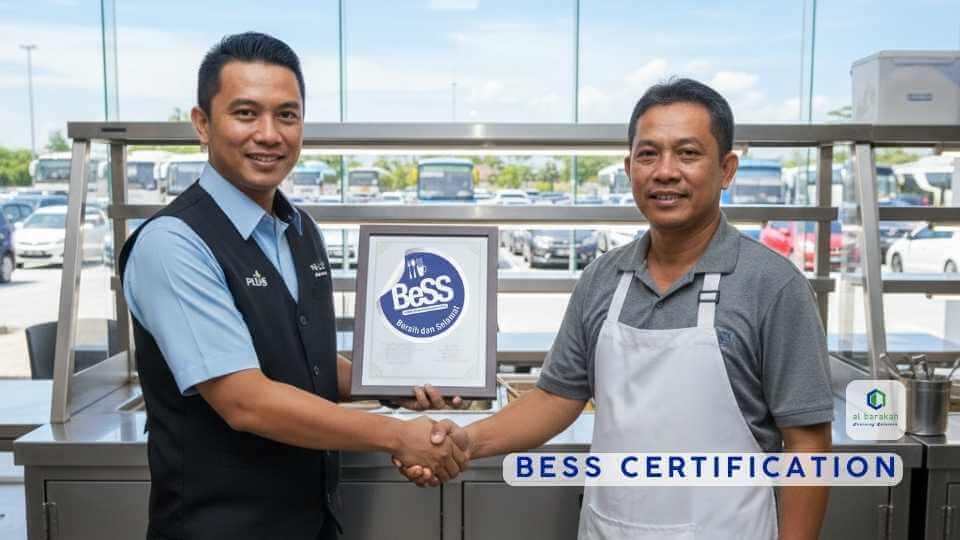
This is where the model enforced by PLUS Malaysia at their highway R&Rs becomes instructive. PLUS management doesn’t leave BeSS as a voluntary option; they mandate it as a compulsory requirement for their food court tenants. This top-down enforcement transforms BeSS from a nice-to-have certificate into a non-negotiable license to operate on their premises.
The Lesson for All Food Court Management
The PLUS case study proves that gold-standard safety is achievable when management leads. By making advanced certifications like BeSS a compulsory part of the tenancy agreement, management can:
-
Raise the entire facility’s safety baseline to an audited, nationally recognized standard.
-
Create a powerful unified brand of “certified safety” for the entire food court, attracting safety-conscious customers.
-
Simplify their own oversight, as MOH’s BeSS audit process supplements their internal checks.
For individual vendors, pursuing BeSS certification—even if not yet compulsory in your location—positions your stall as the premier, most trustworthy choice within the food court. For management, enforcing it is the single most effective strategy to de-risk the entire operation and build a reputation that protects patrons and the nation’s image alike.
Critical Failure Points in Malaysian Food Courts & R&Rs
Vigilance must target these common, high-risk failures:
-
The “Shared Pest” Problem: The #1 cause of mass closures. Inadequate sealing between stall ceilings and walls, and poor common area cleaning, allow cockroaches and rodents to travel freely.
-
Peak-Hour Temperature Collapse: A vendor’s bain-marie, overloaded during lunch rush, cannot maintain safe temperatures. This turns food into a bacterial breeding ground. Understanding these high-risk, scale-related failures in large-scale catering is key to preventing them.
-
Documentation Decay: Expired certificates hidden in drawers instead of displayed. This indicates a culture of neglect and is a red flag for auditors.
-
The “It’s Not My Bin” Mentality: Vendors ignoring overflowing central bins, creating a gridlock of waste and pests that implicates the entire operation.
-
The Halal Integrity Breach: In a shared space, non-Halal ingredients from one stall contaminating the workspace or even the cooking oil supply of a Halal stall. This is both a spiritual violation and a massive reputational disaster.
Building a Proactive Food Safety Culture: From Police to Partner
Transform your food court from a collection of suspicious tenants into a community with shared values.
Organize Group Training Sessions:
- Sponsor or organize bulk training for vendor staff. This builds camaraderie and shows your investment in their success.
Create “Top Vendor” Incentives:
- Publicly recognise vendors with the highest audit scores each month with incentives like temporary rental discounts or prime promotional spots. Make safety prestigious.
Facilitate Knowledge Sharing:
- Create a simple forum for vendors to share best practices on pest proofing, waste management, and efficient GHP.
The Unified Training Solution: Your Lever for Consistent, Nation-Protecting Safety
Chaos demands standardization. For the food court ecosystem to be safe, every participant must speak the same safety language.
For Management & Internal Auditors:
- Your team needs advanced competency in auditing and risk assessment. You must be able to distinguish between a minor lapse and a systemic hazard. This requires training that goes beyond basic food handling.
For Every Vendor and Their Staff:
- They need accessible, comprehensive, and certified training that covers the full spectrum: GHP, HALAL compliance specifics for shared spaces, allergen control, and the science behind temperature control.
The foundation for this entire system is the same: a rock-solid understanding of essential food service training in Malaysia. Before you can enforce standards or pass an audit, you must first establish what those standards are, based on national law and global best practices.
A unified training standard is the only way to ensure that a tourist enjoying a meal at an MBPJ food court or a PLUS R&R receives the same fundamental level of safety as in a five-star hotel. This isn’t just about compliance; it’s about national hospitality standards.
Your Role in Safeguarding More Than Just a Premises
As a vendor, you are not just selling char kuey teow; you are an ambassador of Malaysian street food culture. As a manager for a mall, council, or PLUS, you are not just administering a facility; you are curating a critical piece of national infrastructure that feeds locals and shapes a tourist’s memory of Malaysia.
The strategy is clear:
🎯Standardize your requirements.
🎯Frequent internal inspection with precision,
🎯and educate relentlessly. There is no shortcut.
Our Comprehensive Food Safety Training is uniquely suited for food court ecosystems. We provide training for vendor staff to meet your standards, and specialized audit training for your management team to enforce them.
-
Comprehensive training for vendor staff to meet and exceed your compliance standards.
-
Specialized audit and risk management training for your management team to enforce them with confidence.
Don’t let your food court be the source of a local outbreak—or an international headline. Invest in unified, certified training for your entire ecosystem today.